Home · 1970s – 1990s
1970 – 1999
Foam, fibre and the fire label: the British sofa, 1970s–1990s
In three decades the sofa became a manufactured object: a stapled frame, a block of foam, a cover from a swatch book. This period follows it from the 1970s front room to the corner suite, the recliner and the Chesterfield revival, and explains the 1988 fire regulations that still govern every sofa sold in Britain.
In brief. Between 1970 and 1999 the British sofa stopped being a hand-stuffed object and became a manufactured one: a stapled timber frame, polyurethane foam and polyester fibre in place of hair and springs, and a cover of acrylic velour, cord, leather or printed cotton chosen from a swatch book. The living room changed around it — corner suites and modular units replaced the three-piece suite for many families, the recliner arrived from the armchair trade, and Habitat and flat-pack retailers taught a generation to buy furniture in a box. The single biggest event was the Furniture and Furnishings (Fire) (Safety) Regulations 1988, which forced combustion-modified foam, match- and cigarette-resistant covers and a permanent label on every new sofa sold in the United Kingdom.
- Habitat opens
- 1964Fulham Road, Chelsea; Manchester, Brighton and Glasgow by 1966
- Flat-pack sofa
- 1968Lupton Morton “Campus”: self-assembly beech frame, foam cushions
- Recliner in production
- 1966Parker Knoll’s Recliner Chair introduced; “Statesman” issues file 1972–78
- Modular seating in Britain
- 1977–78“Molecula” system for Race: four elements, any arrangement
- Fire regulations
- 1988SI 1988/1324: foam, match and cigarette tests, permanent label
What did a British living room look like in the 1970s?
By the mid-1970s an ordinary British living room was organised around the television, and its seating was foam over a timber frame rather than hair over springs. The Museum of the Home’s reconstructed front room of 1979, curated by Michael McMillan, shows a working-class British Caribbean family on the De Beauvoir Estate in Hackney gathered for the final episode of Empire Road, with a paraffin heater, a radiogram, crochet doilies and wallpaper of interlocking florals in orange, yellow and burgundy — a front room that was a display space as much as a place to slump.
The seat itself had already changed. An armchair from the “Gambit” range, designed by George Fejer and Eric Phamphilan for Foster-Len Ltd around 1971 and given to the V&A by the maker, is catalogued simply as a wooden frame with an upholstered foam cushion seat and back. That description — frame, foam, cover — is the whole construction of most seating made in Britain for the next thirty years.
Foam also made frameless furniture possible, and the most radical examples came from Italy through Terence Conran’s shops. Mario Bellini’s “Bambole” sofa, bought new by the V&A from the Conran Shop in 1978, has no wooden frame at all: four structures of fibre-reinforced polyurethane foam are “submerged in softer cold-expanded polyurethane” and the hide is pulled around them. Alessandro Becchi’s “Anfibio” sofa-bed, designed in 1969, is a padded tube of polyurethane and Dacron on a steel structure that unlaces into a mattress. Few British homes bought either, but the idea of the sofa as a shaped block of foam with a skin filtered quickly down to the high street.
How did Habitat and flat-pack change the way sofas were sold?
Habitat opened on the Fulham Road in 1964 and had branches in Manchester, Brighton and Glasgow by 1966; the V&A describes it as offering “a lifestyle redolent of a perceived continental sophistication” to “younger, increasingly prosperous and design-conscious consumers”. Its largest branch opened on the King’s Road in 1973, the group bought Mothercare in 1982 and merged with British Home Stores in 1986 — the decade in which Habitat furniture became a fixture of the middle-class living room.
The flat-pack sofa came earlier than most people assume. The Museum of the Home holds a three-seater sofa and matching armchair from the “Campus” range made in 1968 by Lupton Morton Ltd of Wallingford, a mail-order firm it calls “an early pioneer of what was then called ‘knock down’ furniture”; both have a self-assembly beech frame and foam cushions in brown “Hay” fabric. Habitat acquired Lupton Morton in the late 1960s and sold the range as its own. The museum records the United Kingdom’s first IKEA opening in 1987, after which most furniture, in its words, “will arrive ready to be assembled in a brown cardboard box”. The sofa resisted the box longer than the bookcase, but the buying habit — a catalogue, a warehouse, a car boot — reshaped the trade.
When did corner suites and modular seating arrive?
Unit seating that could be rearranged was a 1960s idea from Scandinavia and Italy that British manufacturers took up in the 1970s and sold, in its simplest form, as the corner suite of the 1980s. Ubald Klug’s “D.S-25” of 1974 for De Sede, in the V&A — six stacked sections of foam in green leather, the seat a scooped recess — shows the Continental route: seating as a pile of foam blocks rather than a carved frame.
Milestone · 1977–78
Modular seating and the corner suite
The British version is documented in a single sheet of pencil sketches in the V&A, stamped “A Happy Christmas and New Year 1977–78”. Roger Webb and Robert Heritage’s “Molecula” for Race International Designs was a flexible seating system of “four basic upholstered elements that could fit together in various combinations” — circles, clusters, straight runs and gentle arcs. It was conceived for contract interiors, but the principle is exactly the one the domestic corner suite adopted: build a set of foam-and-frame boxes with matching arms and a corner piece, and let the room decide the shape.
What the buyer got in a 1980s corner group was a set of matching modules — a one-seat unit, an armed end, a square corner — each a small stapled frame with foam seat and back, pushed together. It suited the open-plan lounge-diner and the family that watched television together, and it is the direct ancestor of today’s L-shaped and chaise-end sofas, which still build the corner as its own frame and bolt it to the main sofa.
When did the recliner reach British homes?
The reclining armchair entered mass production in Britain in the mid-1960s and became familiar in the 1970s and 1980s. The Furniture History Society’s dictionary of makers records that Parker Knoll — the High Wycombe firm that had licensed Willi Knoll’s tension-spring seat and launched the brand at the British Industries Fair in 1931 — introduced its “Recliner Chair” in 1966, following the wing “Penshurst” easy chair of 1951, of which more than 370,000 were made over thirty-eight years. The firm’s archive at London Metropolitan University keeps a file on “issues and modifications to the ‘Statesman’ recliner chair” from 1972 to 1978.
Milestone · 1966 onwards
The recliner armchair
The recliner is American in origin — a chair whose back tilts and whose footrest rises on a steel linkage hidden under the upholstery — and the British trade adopted it as a single armchair rather than a sofa. Its arrival marks the point at which mechanism, not stuffing, became the expensive part of a seat: the frame is a box to carry the linkage, the upholstery foam shaped to it. After a fire destroyed the High Wycombe factory in 1970, production moved to Penn Street and Chipping Norton, where Parker Knoll remained family-run until 2000. Neither of the makers whose modern pieces appear at the foot of this page builds a recliner; the fixed high-back wing chair is their nearest form — an honest difference, not a substitute.
What were sofas covered in — Dralon, velour, cord and chintz?
The covers of this period divide into three families — synthetic pile, ribbed cotton cord and the printed cotton “chintz” of the 1980s country-house revival — with leather, for the first time, sold to the mass market rather than the club. The synthetic piles are the ones people remember by trade name. Courtaulds’ acrylic “Courtelle” is documented at the Museum of Design in Plastics in a maker’s teaching sheet of about 1968; the cut-pile acrylics sold as Dralon and the brushed nylons are recalled in every account of the 1970s three-piece suite, though museum collections record few surviving examples. Treat the names as period memory rather than catalogued fact; the material reality was a synthetic pile that wore hard, resisted stains and held a static charge.
Cord and plush were the other face of the decade. The National Trust’s Chesterfield at Croft Castle is a deep-buttoned sofa in brown corduroy on a wooden frame with linen and feather filling — undated in the record, but a clear example of the buttoned Chesterfield re-clothed in ribbed cotton. John Home’s “Diplomat” sofa for HK Furniture, made in 1983 and bought by the V&A the following year, is “heavily upholstered in black and white striped plush”: two seat, two back and five loose cushions on a low two-metre plinth. Mass-produced and sold for about £1,500, it is the pillow-back sofa in its purest form — a padded platform with a pile of cushions in place of a stuffed back.
The 1980s reaction was the country-house look, whose roots are older than the decade. The National Trust holds loose covers for a Kingsway-style sofa in blue and ivory brocatelle, self-piped and hand-hemmed, bought from Sibyl Colefax and John Fowler in 1967 for £56 10s; Fowler’s own home, King Henry’s Hunting Lodge at Odiham, passed to the Trust in 1979. By the 1980s the vocabulary — glazed floral cotton, loose covers, frills and piping — had reached the high street: the V&A acquired five Laura Ashley printed cotton furnishing fabrics in 1985, “Grapes” and “Lily of the Valley” among them, and a 1985 photograph in the same museum of a newly married couple’s living room records armchairs given as a wedding present in a room of “traditional designs, combined with the ideal of comfort”. The loose cover also became a home-sewn object: a fitted cover in washable printed cotton was the cheapest way to make a 1970s suite look like a 1980s one.
Leather and the buttoned Chesterfield came back together. The deep-buttoned hide sofa, a club and library piece in the nineteenth century, was reproduced in numbers for pubs, offices and living rooms from the 1970s, and remains the form most people picture when they hear the word. The revival is easier to see than to document: collections hold the Croft Castle cord example and the Victorian originals, but few of the mass-market leather Chesterfields of the 1970s and 1980s, made by many firms and rarely signed. What can be said is that the fixed buttoned back and low scroll arm made the Chesterfield unusually easy to build from foam and fibre on a stapled frame — one reason so many were made.
What did the 1988 fire regulations change?
The Furniture and Furnishings (Fire) (Safety) Regulations 1988 made it an offence to supply upholstered furniture in the United Kingdom unless its foam, fillings and cover passed specified ignition tests, and required a permanent label saying so. They answered a problem the trade had created for itself: the government’s own review states that makers had replaced wool, cotton and horsehair with cheaper polyurethane foam, and that “these new man-made materials were extremely flammable and the result was a sharp increase in fatalities resulting from house fires”.
Milestone · 1988–93
The Furniture and Furnishings (Fire) (Safety) Regulations 1988
Made as SI 1988/1324, the regulations were phased in. Local-authority guidance records the filling requirements taking effect from 1 November 1988; match-resistant covers and the cigarette test for new furniture from 1 March 1989; permanent labels from 1 March 1990; and from 1 March 1993 an extension to second-hand furniture sold in the course of business, including at auction, with only furniture made before 1 January 1950 — and its re-upholstery — exempt. Amendments followed in 1989 (SI 1989/2358) and 1993 (SI 1993/207); the 1993 change dealt with furniture supplied with let accommodation, allowing non-compliant pieces already in a letting to remain until 31 December 1996.
The tests come from BS 5852, first published in 1979 as a method for assessing “the ignitability by smokers’ materials of upholstered composites for seating”. The cigarette test (Schedule 4) applies ignition source 0, a smouldering cigarette, to the cover-and-filling combination; the match test (Schedule 5) applies ignition source 1, a gas flame equivalent to a match, for twenty seconds to the cover over a standard unmodified foam; and the foam itself must pass the harsher crib 5 test of BS 5852 Part 2 (Schedule 1) — a small wooden crib burned on the sample, with weight loss under sixty grams and no burn-through. Foam that passes crib 5 is combustion-modified foam, and combustion-modified high-resilience foam (CMHR) became the standard seat cushion in British sofas from 1989. A cover that cannot pass the match test alone — some silks and cottons — may be used over a fire-resistant interliner (Schedule 3).
What a buyer sees today. Every sofa made since 1990 must carry a permanent label, stitched to the frame and usually found under a seat cushion or behind a loose cover at the back, headed “CARELESSNESS CAUSES FIRE” and giving the maker’s name and postcode, a batch number and a statement that filling and covers meet the regulations, in type of at least 10 point. For thirty-seven years there was also a display label — the green square or red warning triangle swing tag hung from the arm in the showroom — but the 2025 amendment regulations removed it from 30 October 2025, because the permanent label already carries the compliance information. A sofa bought new this year has no swing tag; one bought between 1990 and 2025 may still have it tucked in the frame. The regulations worked: government research found furniture fires down about 38 per cent by 2007 from the 1987 level, and a 2009 study estimated around 54 lives saved and 800 injuries prevented a year.
How were sofas built in the 1980s and 1990s?
A British sofa of 1990 was built on a stapled timber frame with a sprung or webbed seat platform, foam or fibre cushions and a machine-sewn cover — and one of the decade’s most celebrated designs shows how conservative the inside remained. Jasper Morrison’s sofa of 1988 for SCP Ltd, raised on cast aluminium feet and covered in cotton and linen, is described by the V&A as having “conventional internal construction using beechwood framing and coiled springs”, which the museum contrasts with the elasticated webbing of Continental makers. What changed was the joinery: glued and dowelled joints and pneumatic staple guns replaced the mortise-and-tenon and the tack hammer, and by the 1990s volume makers were mixing hardwood rails with softwood and plywood panels cut from templates. This is a trade account rather than a museum one — few frames of the period have been catalogued — but the staple line under any sofa cover of these decades is the evidence.
The filling settled into a hierarchy. Combustion-modified polyurethane foam, mandatory after 1988, made the seat; a wrap of polyester fibre softened its edges; and at the top of the market a feather-and-down channel cushion, or a feather wrap around a foam core, gave the loose, sink-in look of the pillow-back. The pillow-back and the plinth go together for a practical reason: once the seat is a foam slab on a platform, the back need only be a sloped board to lean cushions on, and the plinth hides the fact that nothing structural sits below the seat.
The same decades transformed the small family upholstery firms of the North West. Workshops in and around Manchester and Salford that had built stuffed-over seats in hair and coil springs into the 1960s moved, one contract at a time, to foam and fibre on stapled frames; the 1988 regulations then obliged every one of them to source combustion-modified foam and keep the batch records the permanent label requires. Some closed, some became contract suppliers, and a few carried the older skills — hand-buttoning, hand-piped scroll arms, a sprung platform under the cushion — into the reproduction Chesterfield market, where they survive today.
By the mid-1990s the British sofa had become a designed object again: Matthew Hilton’s “Orwell” three-seater for SCP survives in the V&A as a 1:5 fibreglass model of February 1996, and Michael Young’s “Magazine” sofa prototype of 1994 won a UK Design Award in 1996 — the Habitat generation grown up, foam, fibre and a frame sold on shape.
Materials: what went where, and why
| Period | Frame | Filling | Cover | Construction |
|---|---|---|---|---|
| c. 1968–75 | Beech, self-assembly (Campus); wood (Gambit) | Polyurethane foam cushions | Wool, “Hay” fabric, acrylic and nylon pile | Knock-down frame; foam block on frame; machine-sewn cover |
| Italian foam sofas, 1969–82 | None (Bambole) or steel tube (Anfibio, Torso) | Fibre-reinforced and cold-cure polyurethane; Dacron | Hide, striped cotton, polyester | Foam as structure; lacing and press-studs; webbing on steel |
| Modular, 1968–78 | Spring steel (Cado); wooden base (D.S-25); upholstered units (Molecula) | Stacked foam layers | Leather, buttoned brown fabric | Units combined in circles, arcs and runs; corner piece |
| Recliner, 1966 on | Timber box carrying a steel linkage | Foam over tension springs | Fabric or hide | Tilting back and rising footrest on a mechanism |
| Pillow-back, 1983 | Plinth base (Diplomat) | Foam seats; loose cushions | Striped plush | Two seat, two back and five scatter cushions on a platform |
| After 1988 | Beech with coil springs (SCP 1988); hardwood, softwood and ply mixes, stapled | Combustion-modified (CMHR) foam; fibre wrap; feather | Match-resistant fabric or leather; interliner where needed | Permanent label; batch number; BS 5852 tests |
Leather or fabric?
For the first time the choice was made on price and fire performance as much as on status. Leather, once the cover of the club Chesterfield and the library chair, was sold to ordinary households on buttoned sofas and low modular units alike — Bellini’s Bambole and Klug’s D.S-25 are both in hide — because it wore, wiped clean and, after 1988, passed the match and cigarette tests without difficulty. Synthetic pile — acrylic velour and brushed nylon — was the cheap, hard-wearing fabric of the three-piece suite, and cord its cotton cousin. The printed cottons of the country-house revival were the most fashionable choice of the 1980s and the most awkward under the new law: a glazed chintz that could not pass the match test alone had to be treated or used over an interliner, which is why many 1990s floral sofas feel stiffer than their 1960s ancestors. The loose cover in washable cotton bridged all three.
What survives in a sofa made today
Six ideas from these three decades are still in production. The comparisons below pair each with a piece made in England today, to make the lineage visible rather than to suggest the modern pieces are reproductions.
Then · 1975–1990
The pillow-backLoose back cushions piled against a low frame — the John Home “Diplomat” of 1983 with its nine cushions — comfort that could be plumped, swapped and washed.

Now · The English Sofa Company
Snowdon scatter-back sofa bedRemovable scatter cushions on a solid hardwood frame with square arms and tapered legs, and a pull-out bed beneath the seat.
See the Snowdon →Then · 1977–78
The corner suiteRace’s “Molecula” sketches: four upholstered elements that fit together in runs, arcs and corners — the logic of the 1980s corner group.
Now · The Chesterfield Company
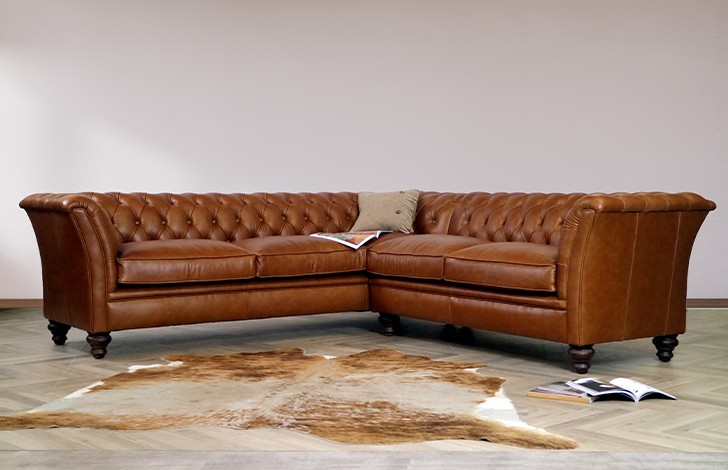
Tatton corner sofaA corner section built as its own beech frame and joined to the main sofa: the modular idea in a buttoned-back form.
See the Tatton corner →Then · 1970s–80s
The Chesterfield revivalThe deep-buttoned sofa reproduced in leather for pubs, offices and living rooms — and in brown corduroy at Croft Castle.

Now · The English Sofa Company
Barrington vintage leather sofaRolled arms, hand-applied buttoning and stud detailing in a top-grain vintage leather made to patinate — the revival Chesterfield as the 1980s wanted it.
See the Barrington →Modern pieces are shown for comparison only. Their frames are solid beech, their seats serpentine-sprung and their cushions foam, fibre or feather-wrapped, all made to the 1988 regulations with a permanent label under the seat. Neither maker offers a recliner; the fixed wing chair is the nearest form they build.
Common misconceptions
“Foam sofas are dangerous.” Unmodified polyurethane foam of the 1970s was; the government review records a sharp rise in fire deaths as it replaced wool, cotton and horsehair. Since 1 November 1988 all foam in new UK furniture must pass the BS 5852 crib 5 test, and the regulations are credited with cutting furniture fires by more than a third.
“Flat-pack furniture came with IKEA in 1987.” The Museum of the Home records Lupton Morton of Wallingford as an early pioneer of “knock down” furniture, with a self-assembly beech sofa in production in 1968 and sold through Habitat from the late 1960s.
“The recliner is an American chair.” The mechanism is American in origin, but Parker Knoll put a British recliner into production in 1966 and refined the “Statesman” through the 1970s; it was made in High Wycombe, Penn Street and Chipping Norton.
“A swing label proves a sofa is compliant.” The display label was never the legal proof; the stitched permanent label headed “CARELESSNESS CAUSES FIRE”, with a batch number, is. The display label was abolished for new furniture from 30 October 2025.
Questions people ask
When did foam replace springs and horsehair in British sofas?
Through the 1960s and 1970s. By about 1971 a mass-market British armchair such as the V&A’s “Gambit” was catalogued simply as a wooden frame with a foam cushion seat and back, and the government’s review of the 1988 fire regulations states that makers had replaced wool, cotton and horsehair with polyurethane foam in the latter half of the century. Some makers, including SCP in 1988, still used beech frames with coil springs under the foam.
What did the 1988 fire regulations actually change?
They made it an offence to supply upholstered furniture unless its foam passed the BS 5852 crib 5 test, its cover passed the match test and the cover-and-filling combination passed the cigarette test, and they required a stitched permanent label. Filling rules applied from 1 November 1988, cover rules for new furniture from 1 March 1989, permanent labels from 1 March 1990 and second-hand sales from 1 March 1993.
What is combustion-modified foam?
Polyurethane foam formulated to pass the crib 5 ignition test in BS 5852 Part 2, in which a small wooden crib is burned on the foam and the sample must lose under sixty grams and not burn through. Combustion-modified high-resilience foam, usually abbreviated CMHR, has been the standard seat cushion in British sofas since the 1988 regulations took effect and is what the permanent label certifies.
What is the difference between a corner suite and a modular sofa?
A modular sofa is a set of separate upholstered units — single seats, armed ends, a corner piece — that can be combined in different arrangements, as in Race’s “Molecula” system of 1977–78. A corner suite is the fixed domestic version: the same units sold as one L-shaped configuration. Modern corner and chaise sofas keep the principle, with the corner or chaise built as its own frame and joined to the main sofa.
When did the recliner armchair arrive in Britain?
Parker Knoll introduced its Recliner Chair in 1966, according to the Furniture History Society’s dictionary of makers, and the firm’s archive holds a file on modifications to the “Statesman” recliner from 1972 to 1978. The mechanism — a tilting back and rising footrest on a steel linkage — is American in origin, but British production made it a familiar armchair through the 1970s and 1980s.
How were 1980s sofas made?
On a stapled timber frame, usually beech or a mix of hardwood rails with softwood and plywood panels, with a sprung or webbed seat platform, combustion-modified foam cushions wrapped in polyester fibre, and a machine-sewn cover. Higher-priced pillow-back sofas such as HK Furniture’s “Diplomat” of 1983 added loose back and scatter cushions on a plinth base; some used feather-wrapped cushions for a softer look.
Was Dralon a good sofa fabric?
Acrylic pile fabrics such as Dralon wore hard, resisted stains and cleaned easily, which is why they covered so many 1970s three-piece suites; their drawbacks were static, heat and a shine that developed with use. Museum collections record few surviving examples, so the specific trade names are better treated as period memory than as catalogued fact. Cotton cord and, in the 1980s, printed cotton chintz were the alternatives.
Is a 1970s or 1980s sofa worth restoring?
Usually only if the frame is sound and the piece has design or family value, because the foam will have degraded and, if the sofa was made before 1 March 1989, its fillings and covers may not meet the fire regulations. Re-upholstery of post-1950 furniture must use compliant foam and covers; a professional upholsterer will replace the foam with CMHR grade and fit a new permanent label.
Does a sofa still need a swing label?
No. The green or red display label that hung from new furniture in showrooms was removed from the regulations by the 2025 amendment, in force from 30 October 2025, because the permanent label carries all the compliance information. The stitched permanent label headed “CARELESSNESS CAUSES FIRE”, with the maker’s details and a batch number, is still required on every new sofa.
What modern sofa is closest to a 1980s corner suite?
A corner or chaise-end sofa built in sections — a corner unit or chaise made as its own frame and bolted to the main sofa — is the direct descendant. Made in England today, such pieces use solid beech frames, serpentine springs and foam, fibre or feather-wrapped cushions rather than the stapled softwood and plain foam of the 1980s, and carry the same permanent fire label.
Sources
- Legislation.gov.uk, The Furniture and Furnishings (Fire) (Safety) Regulations 1988, SI 1988/1324 — legislation.gov.uk/uksi/1988/1324
- Legislation.gov.uk, amendment regulations SI 1989/2358, SI 1993/207 and SI 2025/531 — legislation.gov.uk/uksi/1989/2358
- GOV.UK (Office for Product Safety and Standards), Furniture and Furnishings (Fire) (Safety) (Amendment) Regulations 2025: UK — gov.uk
- GOV.UK (BEIS), Furniture and furnishings fire safety regulations: consultation, 2016 (history, foam, fire statistics) — assets.publishing.service.gov.uk
- Blaby District Council, A Guide to the Furniture and Furnishings (Fire) (Safety) Regulations; London Borough of Bromley Trading Standards, upholstered furniture fire safety leaflets (label wording) — blaby.gov.uk
- BSI Knowledge, BS 5852-1:1979, Fire tests for furniture: ignitability by smokers’ materials of upholstered composites for seating — knowledge.bsigroup.com
- V&A, “Diplomat” sofa, John Home for HK Furniture, 1983, W.39:11-1984 — collections.vam.ac.uk/item/O125191
- V&A, sofa, Jasper Morrison for SCP Ltd, 1988, W.16:1 to 3-1990 — collections.vam.ac.uk/item/O71108
- V&A, “Orwell” sofa model, Matthew Hilton for SCP, 1996, W.21-2005; “Magazine” sofa prototype, Michael Young, 1994, W.11-2011 — collections.vam.ac.uk/item/O115287
- V&A, armchair, “Gambit” range, Fejer and Phamphilan for Foster-Len Ltd, c. 1971, W.44-1979 — collections.vam.ac.uk/item/O372052
- V&A, “Bambole” sofa, Mario Bellini for C&B Italia, W.40-1978; “Anfibio” sofa-bed, Alessandro Becchi for Giovannetti, W.57-1979 — collections.vam.ac.uk/item/O371734
- V&A, “Molecula” seating system design, Webb and Heritage for Race, 1977–78, E.882-1979; “D.S-25” seating unit, De Sede, 1974, W.51-1979; “Cado 181.00” unit, 1968, W.38-1978 — collections.vam.ac.uk/item/O111396
- V&A, Laura Ashley furnishing fabrics, 1985, T.12 to T.16-1985; photograph “Living room looking towards the dining table”, John R.J. Taylor, 1985, E.32-1990 — collections.vam.ac.uk/item/O270649
- V&A blog, “Terence Conran – a V&A perspective”; Design Museum, Sir Terence Conran timeline (Habitat 1964–86) — vam.ac.uk
- Museum of the Home, Rooms Through Time: A Front Room in 1979 — museumofthehome.org.uk
- Museum of the Home, “Campus” sofa and armchair, Lupton Morton Ltd, 1968, 45/2001 and 47/2001; “BILLY, the world’s favourite bookcase” (knock-down furniture, IKEA 1987) — collections.museumofthehome.org.uk/object28035
- National Trust Collections, Chesterfield in brown corduroy, Croft Castle, NT 537519; loose covers by Sibyl Colefax and John Fowler, 1967, Dudmaston, NT 814414; “Morocco Trellis” wallpaper, King Henry’s Hunting Lodge, NT 808954 — nationaltrustcollections.org.uk/object/814414
- Furniture History Society, BIFMO: Frederick Parker & Sons; Parker Knoll (1869–2000) — bifmo.furniturehistorysociety.org
- London Metropolitan University, Frederick Parker Archive: Parker Knoll “Statesman” product issues, 1972–1978, FP/F/104 — collections.londonmet.ac.uk
- Museum of Design in Plastics (Arts University Bournemouth), “The Manufacture of Courtelle”, Courtaulds, c. 1968 — modip.ac.uk