Home · 2000s to today
2000 – now
The sofa now: modular, motorised, and the Chesterfield reborn
The twenty-first century gave the sofa its first motor, its first cardboard box and its oldest form back again. This final period follows the low, deep, modular sofa from the design museums into the open-plan living room, explains the electric recliner as the machine the law says it is, and ends on the bench where a sofa is still made, layer by layer, today.
In brief. Since 2000 the sofa has become deeper, lower and more often L-shaped or modular, and for the first time it has acquired motors: the electric recliner with power headrests and USB sockets is the period’s one new mechanism. At the same time the deep-buttoned Chesterfield came back into fashion, usually in a waxy “vintage” leather, so the newest and oldest forms now share a showroom. Underneath, construction has settled into a recipe — timber frame, serpentine springs, foam, fibre or feather cushions, a graded cover and a fire label — while the 1988 fire regulations that shaped every layer are being rewritten.
- Low, deep, modular
- 2001The Bouroullecs’ Glide sofa: foam on steel, with a shelf for the remote
- The small-flat sofa
- 2011Yuya Ushida’s expanding Sofa_XXXX, 8,000 chopsticks, now in the V&A
- The electric sofa regulated
- 2017–18Motorised furniture confirmed as machinery; FIRA’s compliance guide follows
- Seating tested
- 2024BS EN 12520 revised: strength, durability, finger entrapment
- Fire rules rewritten
- 2023–26Two consultations and a 2025 amendment to the 1988 regulations
How did the sofa change shape after 2000?
The sofa of this century is lower, deeper and longer, and far more likely to turn a corner. The Design Museum’s survey of the decade’s seating opens with Jerszy Seymour’s PlayStation chair of 2000, a foam-and-vinyl hybrid of armchair and chaise built for a games console, and Ronan and Erwan Bouroullec’s Glide sofa of 2001, foam on a steel frame with a shelf in the back for discs and controllers — a sofa, the museum says, whose function the user decides.
The domestic evidence is in the Museum of the Home. Its high-rise flat of 2005 belongs to three flatmates who have painted every wall a different colour; its terraced house of 2024, curated with London’s Vietnamese community, is an open-plan kitchen-living room with a floral throw across the sofa and the television on the wall. Between those rooms the sofa stopped being one of three matching pieces facing a fireplace and became a single long object, often L-shaped, facing a screen. A corner sofa is two or more sprung frames bolted together, each small enough for a doorway; from there it is a short step to the modular system and the sofa in a box.
Milestone · 2000s–2020s
Modular sofas and the sofa-in-a-box
The clearest museum object for the small-flat sofa is not a commercial product. Yuya Ushida’s Sofa_XXXX of 2011, V&A W.16-2012, is made from about 8,000 bamboo chopsticks and 2,000 stainless-steel rings, paired in Xs and riveted so that seven interlocking elements expand like a bridge truss: it seats three closed and five open. Ushida said he was addressing “living in small spaces”, and the piece states the century’s problem exactly: the sofa must now fit a flat, a lift and a courier’s van.
The commercial answer is the modular or in-a-box sofa: foam seats vacuum-compressed and rolled, frames delivered as units that clip or bolt together so a two-seater can grow into a corner. No museum on the approved list has yet collected one; the form is documented instead by the law governing its sale. Gov.uk sets out the rule for goods bought unseen: the customer may cancel within fourteen days of receiving them and has fourteen more to return them, except for personalised or custom-made items, which need only be refunded if faulty. A sofa made to order in a chosen cover is custom-made; a stock sofa in a box is not.
When did the electric recliner sofa arrive, and how does it work?
The powered recliner is the first new sofa mechanism since the Victorian patent era. No collection cited on this site records one, so the trail is technical. In July 2017 the Furniture Industry Research Association issued an urgent update: European guidance had confirmed that “electrically operated furniture, such as beds, chairs, tables, storage furniture including kitchen furniture, remain subject to the Machinery Directive”. FIRA’s compliance guide for electrically actuated domestic furniture followed, its third version dated March 2018.
Milestone · 2000s–present
The electric recliner sofa
In general terms the mechanism is simple. Inside each reclining seat is a folding steel linkage — the lever geometry of a manual recliner — driven not by a handle but by a linear actuator: a small motor turning a threaded rod that pushes the footrest out and the back down. A power headrest adds a second, smaller actuator. Because the motors run at low voltage, a transformer under the sofa converts mains current, and the same line feeds the USB sockets in the arm. The better systems, in FIRA’s words, include “collision detection”.
The guide also explains why the law treats a sofa with a motor as a machine. Its listed hazards are “crushing” and “drawing-in or trapping” as the footrest closes, together with shock and fire. A recliner sold in Great Britain must satisfy the Supply of Machinery (Safety) Regulations 2008 and the Electrical Equipment (Safety) Regulations 2016 as well as the fire regulations; BS EN 12520:2024 for seating tests “finger entrapment and shear and compression”, and in August 2025 FIRA reported BS EN 17684 and EN 60335-2-116, standards written specifically for electrically operated furniture, in preparation.
For the buyer this reduces to what FIRA says a maker must supply: the conformity mark (UKCA or CE) with the maker’s name and address on the product itself; a declaration of conformity; instructions with “warnings concerning ways in which the product must not be used”; and, sensibly, a manual release for power cuts. Neither English workshop whose pieces appear on this site makes a recliner; what this page can say is that a recliner is a machine and should be bought with a machine’s paperwork.
Why did the Chesterfield come back?
The deep-buttoned leather sofa returned in the 2000s as a deliberate piece of nostalgia. The form itself is loosely dated: the National Trust’s Chesterfield at Croft Castle (NT 537519) is catalogued as wood, linen, feather and brown corduroy, date unknown — a reminder that “Chesterfield” names a construction, a buttoned back and arms of one height over a sprung seat, rather than a period. The V&A holds no object catalogued as a Chesterfield sofa; a search returns only Roubiliac’s bust of the fourth Earl, and the tradition that he commissioned the first one remains unverified.
Milestone · 2000s–present
The Chesterfield revival and the “vintage leather” look
What changed after 2000 was the cover. The revived Chesterfield is more often a waxy or oil-pull-up aniline that lightens where it creases, so a new sofa looks decades old within weeks, than the glossy pigmented hide of the 1980s. The leather guide of one English maker cited below describes the effect on its own hides: an “antique rub-off” leather with “a darker topcoat that can be rubbed off to reveal a lighter underlayer”, and vintage anilines that “develop a unique patina over time”. No museum has yet written the history of this fashion, and its dates here are the makers’, not a curator’s. Its versions divide into the faithful reproduction with rolled arms and studs and the “modern Chesterfield” with squarer arms, shallower buttoning and a loose seat cushion — the one most often chosen for a flat.
Foam, fibre or feather: what is inside a modern cushion?
Almost every sofa made today has one of three fillings, and the choice governs how it feels more than anything else. Polyurethane foam is the workhorse: the V&A’s Pyrenees sofa of 2007–11 by Fredrikson Stallard is a single block of it, hand-carved into a mountain range on a steel frame; Ron Arad’s Soft Little Heavy of 1993 is “high-density cold foam injection” on steel. In an ordinary sofa the foam is cut and graded by density. Fibre — polyester wadding, usually siliconised so it springs back — is the softer, cheaper alternative and the standard filling on the contemporary pieces below, with foam or feather as upgrades. Feather, the oldest filling, is now most often a feather-and-down wrap around a foam core, giving the sink-in look of the Croft Castle Chesterfield with foam’s recovery. Since 1988 every filling sold here has had to pass an ignition test under regulation 6 of the fire regulations.
Serpentine, coil or pocket: how are modern sofas sprung?
Most British sofas today are sprung with serpentine (“zig-zag”) wire rather than Victorian coils. A serpentine spring is hardened steel wire bent into a continuous S, clipped front rail to back rail and linked sideways with helicals; it needs no webbing, no hand-tying and little depth, which suits the low modern seat. Coil springs — hourglass steel sewn to webbing, tied eight ways and covered with hessian — survive in traditional workshops and the dearest reproduction Chesterfields; pocket springs, each coil in its own sleeve, are borrowed from mattresses for some deep cushions and sofa beds. No museum record on the approved list describes a modern sofa’s springs, so this page relies on the standard that tests them: BS EN 12520:2024 specifies seat durability tests for a user of up to 110 kg and adds “loading points for seating with suspended flexible materials” — its phrase for a webbed or serpentine seat.
Solid beech or engineered frame?
The traditional frame is kiln-dried hardwood, usually beech, glued, dowelled and screwed; both English workshops cited below build in solid beech and guarantee it for fifteen years. The alternative is engineered board, machine-cut and stapled, lighter and cheaper, and the reason a boxed sofa can exist at all. The buyer’s protection is the frame guarantee and a maker who will name the timber. Sustainability is regulated separately: since 1 January 2021 the UK Timber Regulations have prohibited illegally harvested timber and required the first company placing it on the market to run a documented due-diligence system, and the Government’s procurement policy demands proof of legal and sustainable sources with full chain of custody, naming the Forest Stewardship Council, PEFC and Grown in Britain as the schemes it accepts. A frame labelled FSC is using the evidence the state demands of its own suppliers.
What do leather grades actually mean?
Leather is graded by how much of the hide’s surface survives and how much is covered, and the vocabulary is standardised in BS 2780, the glossary of leather terms first published in 1983 and amended in 2013. Full-grain aniline keeps the surface intact and is coloured only with transparent dye, so scars show and it marks easily; semi-aniline adds a thin pigmented finish while showing most of the grain; corrected-grain or pigmented leather is buffed, embossed with an artificial grain and sealed with an opaque coat — the most uniform and stain-resistant, and the least natural. The English maker’s guide cited below uses these categories for its own hides — an antique rub-off range, a “full grain corrected” range “resistant to scratches and stains”, and three aniline ranges including nubuck; those descriptions apply only to that maker’s hides.
Two materials sold as leather deserve a plain warning. “Bonded leather” is not a hide but ground leather fibre bound in polyurethane with a printed plastic face, which peels from its backing within a few years. “Bicast” is a thin split laminated with a glossy polyurethane film; the film is what you touch, and it cracks. Neither belongs on a sofa meant to last.
What is happening to the 1988 fire regulations?
The Furniture and Furnishings (Fire) (Safety) Regulations 1988 are being rewritten, and the process explains more about the modern British sofa than any museum object. The regulations require fillings to pass ignition tests (regulation 6), the upholstery composite to resist a smouldering cigarette (schedule 4, adapted from BS 5852) and the cover to resist a lit match (schedule 5), and require every new item except a mattress to carry a permanent label (regulation 11). In practice the match test was met with chemical flame retardants. The Office for Product Safety and Standards consulted from 2 August to 24 October 2023 on an outcomes-based regime; it drew 566 written responses, many arguing that the open-flame test itself drove the chemistry.
On 22 January 2025 the Government’s policy paper concluded that the regulations had “contributed significantly to protecting consumers for more than three decades” but were “out of step with modern approaches to product safety” and “a potential barrier to innovation and the circular economy”. Amendment regulations in force from 30 October 2025 removed the paper display label and took children’s products out of scope; the permanent label survives. Then on 31 March 2026 a second consultation, closing 23 June, proposed the real reform: requirements “based on a smoulder test” in place of the match and crib tests and moving re-upholstery and second-hand furniture into general product-safety law, to maintain “a high level of fire safety while meaningfully reducing chemical flame retardant use”. The new regulations had not been made when this page was written.
Reupholstery, repair and the second-hand sofa
The sofa is one of the few pieces of furniture that can be rebuilt indefinitely, and the century has rediscovered the fact. A solid-timber, serpentine-sprung frame can be re-covered, re-cushioned and re-sprung by any upholsterer, which is why the frame guarantee matters more than the cover’s; a stapled board frame with foam glued to it usually cannot. The “right to repair” rules of March 2021 cover appliances, not furniture. The fire regulations have worked the other way — a re-covered Victorian sofa has needed match-test cloth like a new one, and a second-hand sofa without its label has been hard to sell lawfully, precisely the barrier the 2026 consultation proposes to remove. The Museum of the Home’s newest room, a converted flat of 2049 by Northumbria University’s Interaction Research Studio, imagines the outcome: a storage sofa, mycelium insulation panels that renters carry from flat to flat, and furniture built to be moved and reused.
Materials: what goes where, and why
| Period | Frame | Filling | Cover | Construction |
|---|---|---|---|---|
| Design-led, 2000–11 | Steel | Polyurethane foam, moulded or carved | Vinyl, wool, printed textile, flocked fibre | Foam on a metal chassis |
| Traditional English workshop | Solid beech, glued, dowelled, screwed | Foam, siliconised fibre or feather-wrapped foam | Aniline, semi-aniline or corrected leather; fabric | Serpentine springs; hand-buttoning; 15-year frame guarantee |
| Modular and sofa-in-a-box | Engineered board | Compressed foam and fibre | Polyester blends, removable covers | Webbing or serpentine; units clipped or bolted; vacuum-packed |
| Electric recliner | Timber or steel with folding linkage | Foam and fibre | Corrected leather; fabric | Linear actuators, low-voltage supply, USB; machinery regulations apply |
| Chesterfield revival | Solid beech or hardwood | Fibre pad and foam; feather in loose cushions | Waxy, rub-off and pull-up aniline | Deep buttoning through the pad; sprung seat; brass studs |
| All, since 1988 | — | Ignition-tested fillings | Cigarette- and match-resistant composite | Permanent label; smoulder-only test proposed 2026 |
Leather or fabric?
Leather remains the cover chosen for wear and fabric the cover chosen for softness, colour and price. A corrected-grain leather is the most practical cover ever made — wipeable, colour-fast, forgiving of pets — but it is a painted surface on a sanded hide and will always look the same; an aniline shows the animal and the years, and marks accordingly. Fabric now runs from wool and velvet to performance synthetics, and the removable cover is a way to wash a sofa or change its colour. What no cover escapes, until the rules change, is the match test: every fabric sold for a British sofa has been treated or interlined to pass it.
How a sofa is made today
The site ends where the sofa begins, on the frame bench, where everything the eight periods describe is still done, in order. The frame comes first: kiln-dried beech cut to pattern, rails glued and dowelled, corners blocked and screwed — or, in a factory making boxed sofas, board panels machine-cut and stapled into a carcase in minutes. Then the springing: serpentine wire clipped rail to rail and linked with helicals, or coils sewn to webbing and hand-tied, or elastic webbing stretched across the seat. Then the padding: hessian over the springs, a fibre or hair pad, then foam cut to the profile of seat, arms and back and wrapped in polyester; on a Chesterfield the buttons are pulled through pad and cover together now, each tied off on the frame behind. Then the cover: leather or fabric cut to templates, sewn into a sleeve for each section, pulled over the padding and stapled to the frame, finished with studs or piping where cover meets wood, the loose cushions filled last. And then the fire label, required by regulation 11 of the 1988 regulations, sewn to the frame under the seat, naming the maker and the tests passed — the one part of the modern sofa with no ancestor before 1988.
What survives in a sofa made today
The comparisons below pair each of the century’s ideas with a piece made in England today that embodies it. None is a recliner; the note beneath says what to look for if that is what you need.
Now · 2000s–present
The modern ChesterfieldSquarer arms, shallower buttoning, a loose seat cushion — the Chesterfield made to fit a flat.
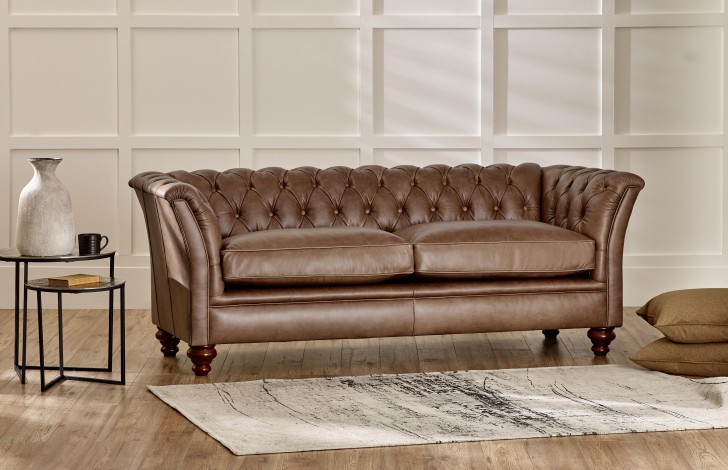
Now · The Chesterfield Company
Tatton contemporary sofaSolid beech frame, serpentine springs, deep foam seat; leather from corrected full grain to aniline.
See the Tatton →Now · 2000s–present
The modular sofaSeating sold by the module — one to four sections, arms bolted on or left off — and configured to the room rather than the other way round.

Now · The English Sofa Company
Newbury modular sofaSolid hardwood frames in one- to four-module runs, optional bolt-on arms, and cushions from fibre to feather-topped.
See the Newbury →Now · 2000s–present
The Chesterfield revivalDeep button tufting and rolled arms brought back in a patinating leather or a plain wool.

Now · The English Sofa Company
Harris contemporary ChesterfieldHardwood frame; cushions in siliconised fibre as standard, or foam, feather-wrapped or feather-topped.
See the Harris →Now · 2000s–present
Subtle buttoning, clean lineKeeping the Chesterfield’s signature while stripping its ornament.
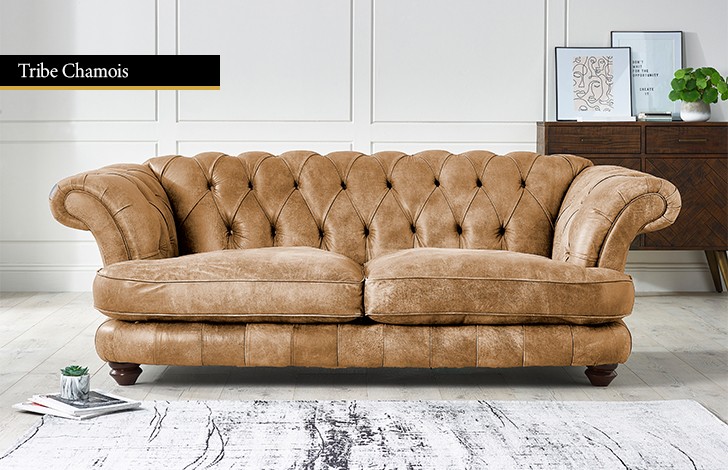
Now · The Chesterfield Company
St Edwin modern ChesterfieldSquared arms, minimal studding, serpentine springs and foam-and-fibre cushions on a solid frame.
See the St Edwin →Now · 2000s–present
The chaise endThe open, one-armed seat the modular sofa made normal — the day-bed of 1690 returned as a corner unit.

Now · The English Sofa Company
Churchill grey leather chaiseScroll arms and a deep seat running into a left- or right-hand chaise end, on a solid beech frame with serpentine springs.
See the Churchill chaise →Now · 2000s–present
Leather graded and namedAniline, semi-aniline, corrected grain: the buyer is now expected to know the difference.
Now · The English Sofa Company
Leather collections guideThe maker’s own grades — antique rub-off, full-grain corrected and three aniline ranges — and the patina each will show.
See the leather guide →Modern pieces are shown for comparison only. Neither workshop makes a recliner: their frames are fixed solid beech, sprung with serpentine springs and filled with foam, fibre or feather, and their nearest answer to the reclining L-shape is the corner and chaise range. If you need a powered recliner, buy it as the machine it is — conformity mark and maker’s address on the product, a declaration of conformity, a manual release for power cuts — and ask for the same frame guarantee and named leather grade you would of any other sofa.
Common misconceptions
“Modern sofas are all foam and cardboard.” Some boxed sofas are, but the traditional build — solid beech, serpentine or coil springs, fibre or feather cushions — is in production in English workshops today, and BS EN 12520:2024 tests both to the same durability requirements.
“Bonded leather is leather.” It is ground leather fibre in polyurethane with a printed plastic face, and it peels. Ask whether a hide is aniline, semi-aniline or corrected grain.
“The fire label means the sofa is full of toxic chemicals.” It records that fillings and cover passed the 1988 tests, which were usually met with flame retardants — exactly what the 2023 and 2026 consultations set out to change. The label is a record of testing, not a list of ingredients.
“An electric recliner is just a sofa with a motor.” In law it is a machine: FIRA’s guidance confirms motorised furniture falls under the Supply of Machinery (Safety) Regulations 2008 as well as the electrical and fire regulations, and entrapment at the closing footrest is the hazard the standards are written around.
Questions people ask
When did electric recliner sofas become common in Britain?
Electric recliners spread through the 2000s and 2010s, but the clearest dated record is regulatory: in July 2017 FIRA warned the trade that motorised furniture is legally machinery, and its compliance guide for electrically actuated domestic furniture reached its third version in March 2018. No museum in the sources used here has yet collected an electric sofa.
How does an electric recliner sofa work?
A folding steel linkage under each seat is driven by a linear actuator, a small motor turning a threaded rod that pushes the footrest out and the back down. A transformer under the sofa converts mains current to the actuator’s low voltage and also feeds any USB sockets; power headrests use a second, smaller actuator. Better systems include collision detection.
What should I check when buying an electric recliner?
Look for the UKCA or CE conformity mark with the maker’s name and address on the sofa itself, ask for the declaration of conformity, check the instructions carry warnings about misuse, and look for a manual release or battery back-up for power cuts. Keep children and pets clear of a closing footrest: entrapment is the hazard the standards are written around.
What is the difference between aniline, semi-aniline and corrected-grain leather?
Aniline leather keeps the hide’s natural surface and is coloured only with transparent dye, so it marks and patinates. Semi-aniline adds a thin pigmented finish for protection while showing most of the grain. Corrected-grain or pigmented leather is buffed, embossed with an artificial grain and sealed with an opaque coat: the most uniform and stain-resistant, and the least natural-looking.
Why should I avoid bonded or bicast leather?
Bonded leather is not a hide but ground leather fibre bound in polyurethane with a printed plastic face; the face peels from the backing within a few years. Bicast is a thin split laminated with a glossy polyurethane film that cracks. In both cases the surface you touch is plastic, so neither wears or ages like leather.
What is the difference between serpentine, coil and pocket springs?
Serpentine springs are zig-zag steel wires clipped from front to back rail and need little depth, which suits low modern seats. Coil springs are hourglass springs sewn to webbing and hand-tied, the Victorian method still used in traditional workshops. Pocket springs are coils in individual fabric sleeves, borrowed from mattresses and used in some deep cushions and sofa beds.
How is a sofa made today?
In order: a frame of kiln-dried beech or engineered board is glued, dowelled and screwed or stapled; springs or webbing are fixed across the seat; hessian, a fibre pad and shaped foam are built up over them; the cut and sewn leather or fabric cover is pulled over and stapled to the frame; loose cushions are filled with foam, fibre or feather; and a permanent fire label is sewn to the frame.
Is a sofa in a box worth buying?
It can be, for a first flat or a room with narrow access, and the law gives fourteen days to cancel a distance purchase of stock goods. Its limits are the engineered frame and compressed foam, which are rarely rebuildable. A solid-timber, serpentine-sprung frame with a long guarantee can be re-covered and re-sprung for decades, which is why the frame matters more than the cover.
What is changing in the UK furniture fire regulations?
The 1988 regulations are being rewritten. A 2023 consultation led to a January 2025 policy paper; amendment regulations in force from 30 October 2025 removed the display label and took children’s products out of scope; and a consultation published on 31 March 2026 proposed replacing the match test with a smoulder test to reduce chemical flame retardants. The permanent label remains.
What modern sofa is closest to a 21st-century modern Chesterfield?
The form called a modern or contemporary Chesterfield: squarer or gently rolled arms, shallower buttoning, minimal studding and a loose seat cushion on a solid beech frame with serpentine springs. English workshops make it today in aniline, semi-aniline or corrected leather and in fabric, and as a corner or chaise version for open-plan rooms.
Sources
- FIRA International, Electrically actuated furniture for the domestic market: a guide to compliance, v3.0, March 2018 — fira.co.uk
- FIRA, Urgent update: motorised furniture, July 2017 — fira.co.uk
- FIRA, Smart furniture 2025: innovation, standards and what’s next (BS EN 17684, EN 60335-2-116), August 2025 — fira.co.uk
- BSI, BS EN 12520:2024 Furniture. Safety, strength and durability. Requirements for domestic seating — knowledge.bsigroup.com
- BSI, BS 2780:1983+A1:2013 Glossary of leather terms — knowledge.bsigroup.com
- legislation.gov.uk, The Furniture and Furnishings (Fire) (Safety) Regulations 1988, SI 1988/1324 — legislation.gov.uk/uksi/1988/1324
- GOV.UK (OPSS), Smarter Regulation: fire safety of domestic upholstered furniture, consultation 2 Aug–24 Oct 2023 and summary of responses, 22 Jan 2025 — gov.uk
- GOV.UK (OPSS), Fire safety of domestic upholstered furniture: policy paper, 22 January 2025 — gov.uk
- GOV.UK (OPSS), Furniture and Furnishings (Fire) (Safety) (Amendment) Regulations 2025: guidance — gov.uk
- GOV.UK (OPSS), Product regulation: fire safety of domestic upholstered furniture, consultation 31 March–23 June 2026 — gov.uk
- GOV.UK, Regulations: timber and FLEGT licences (UK Timber Regulations) — gov.uk
- GOV.UK, Timber Procurement Policy: prove legality and sustainability (FSC, PEFC, Grown in Britain) — gov.uk
- GOV.UK, Accepting returns and giving refunds: the law — gov.uk
- GOV.UK, Electrical appliances to be cheaper to run and last longer with new standards (right to repair), 10 March 2021 — gov.uk
- V&A, Pyrenees sofa, Fredrikson Stallard, 2007–11, W.25-2011 — collections.vam.ac.uk/item/O1243278
- V&A, Sofa_XXXX, Yuya Ushida, 2011, W.16-2012 — collections.vam.ac.uk/item/O1254532
- V&A, Soft Little Heavy chair, Ron Arad for Moroso, 1993, W.6-1994 — collections.vam.ac.uk/item/O50991
- National Trust Collections, Chesterfield sofa, Croft Castle, NT 537519 — nationaltrustcollections.org.uk/object/537519
- Design Museum, Chairs: 2000s (PlayStation chair, Glide sofa, Repeat sofa) — designmuseum.org
- Museum of the Home, Rooms Through Time: a high-rise flat in 2005; a terraced house in 2024; a converted flat in 2049 — museumofthehome.org.uk