Home · Victorian
1837 – 1901
The Victorian sofa: coil springs, deep buttoning and the Chesterfield
The sofa most people picture is Victorian: low, sprung, buttoned, upholstered to the floor. This period follows the coil spring from a patent of 1828 into every drawing room, watches the Chesterfield settle into its familiar shape, and ends with Morris & Co taking the stuffing out again.
In brief. Between 1837 and 1901 the sofa acquired the construction it kept for a century: coil springs under stitched horsehair, deep buttoning through the cover, and a low, padded profile in which upholstery rather than show-wood made the shape. The Chesterfield — arms level with the back, deep-buttoned leather, a low sprung seat — reached its familiar form in this period, though no museum record cited here confirms the story that an Earl of Chesterfield commissioned the first one. Mass production after the Great Exhibition of 1851 put sprung, buttoned seating into middle-class parlours, and the Arts and Crafts reaction produced the rush-seated Sussex chair and the adjustable-back “Morris” chair.
- Coil springs patented
- 1828Standard for domestic seating by the 1830s; nearly universal by 1850
- The Great Exhibition
- 1 May–11 Oct 1851Six million visitors; 244 objects bought to found the V&A
- Deep buttoning in the trade
- 1860–80Albert Bentley’s upholsterer’s models, crimson damask, buttoned throughout
- Morris & Co’s Sussex chair
- c. 1860Ebonised beech, rush seat — the reaction to stuffed comfort
- Howard & Sons’ royal warrant
- 1901Upholstered goods to Edward VII; “Elastic Seats” patented 1866
When did coil springs become standard in sofas?
Coil springs became the normal construction for British domestic seating in the 1830s, within a decade of the Queen’s accession. The Museum of the Home, describing a spoon-back armchair of about 1860, records that coiled steel springs were patented in 1828 and became standard in the mid-nineteenth century, allowing bulkier forms and deep buttoning that conveyed both comfort and luxury. The V&A, on an ebonised settee of about 1845–60, is more precise: spiral springs had been used for specialised furniture in the late eighteenth century, became standard for domestic seating only in the 1830s, and by 1850 almost every drawing-room chair or settee was sprung.
What a spring does to a seat can be seen on one chair. The V&A’s walnut parlour chair of about 1845 keeps its original upholstery: six copper-coated steel coil springs stitched to the webbing and compressed under a tacked cover, with stitched horsehair on top. The springs gave extra resilience, the museum says, and resulted in an increase in the depth of the upholstery. That is the whole Victorian profile in a sentence. A sprung seat needs a deep box to hold the springs, and the box is covered in cloth; the show-wood drops to a moulding at the foot or vanishes, and the sitter sinks lower and further back. Henry Eyles of Bath sent a walnut easy chair to the Great Exhibition of 1851; the V&A found its original springs and webbing intact beneath a later velvet.
Milestone · 1830s–1860s
Coil springs and deep buttoning become the standard construction
By mid-century the two techniques had fused into one method: webbing stretched across the frame, springs sewn to it and lashed down, coarse cloth over the springs, horsehair built up and stitched into a firm edge, wadding to smooth it, and the top cover pulled through and held with buttons. The V&A’s best evidence for the finished look is a set of six miniatures — a circular ottoman, a chaise longue, two armchairs and two footstools — made in 1860–80 by the London upholsterer Albert Bentley, who worked at Buckingham Palace and Marlborough House. Their under-upholstery is glazed linen and wadding, their covers crimson silk damask, deep-buttoned throughout. The museum acquired them because full-sized seating with untouched upholstery from these decades is exceptionally rare.
Why were Victorian sofas deep-buttoned?
Deep buttoning was a practical answer to a practical problem, and only then a fashion. Loose horsehair on a sprung seat or padded back migrates and lumps with use; the earlier remedy, seen on seventeenth-century chairs, was to stitch through the stuffing at intervals. Pulling the cover itself down into the stuffing and holding it with a button does the same job more thoroughly, dividing the filling into cells that cannot shift. The V&A’s Belter sofa of about 1856 shows how permanent the pattern was: when it was conserved, the original horsehair pads still carried the original buttoning pattern, which guided the new cover.
The second reason was display. Buttoning uses more cloth and far more labour than a stretched cover, and the diamond folds catch the light in silk, velvet or leather. The Museum of the Home says plainly that the technique conveyed comfort and luxury; a buttoned back announced that its owner had paid an upholsterer for days of work. Bentley’s crimson models are buttoned on every surface, which is what a firm working for the royal household would want a client to see.
What did the Great Exhibition of 1851 change?
The Great Exhibition turned furniture into a spectacle and fixed the mid-Victorian taste for display. It opened in Paxton’s Crystal Palace on 1 May 1851 and closed on 11 October, having received more than six million visitors and nearly fourteen thousand exhibitors; the V&A records that 244 objects were bought from it for the Government School of Design, the seed of the museum that opened in 1857. Its sections — raw materials, machinery, manufactures and fine art — put the machine and the upholsterer’s shop under one glass roof.
The machine had been coming for some time. The Science Museum holds a mahogany veneer cut in 1791–93 on machinery patented by Samuel Bentham in 1793, forerunner of his production line for pulley blocks at Portsmouth after 1804. By mid-century the V&A places moulded veneer in industrial use and cites Belter’s New York patent of 1858, which let chair backs be made in batches of eight from a single mould, cutting time and cost. Not everyone approved: Henry Cole staged an exhibition of “False Principles in Design” at Marlborough House in 1852, in which a glazed cotton shown at the Great Exhibition by a London furnishing shop was catalogued as item sixteen, condemned for its imitation of ribbon upon chintz. Whether a machine-made thing should pretend to be something else was the argument of the next fifty years.
What are balloon-back and spoon-back chairs, and where did the chaise longue and ottoman fit?
The balloon-back was the standard Victorian side chair and the spoon-back its upholstered, sprung cousin. The V&A holds balloon-backs of about 1850–55: a mahogany side chair with turned front legs and a woven horsehair seat, and a child’s version of 1845–55 stained to look like rosewood, with the downward-curving hoop of the back and a curved bar across its centre. These were dining and bedroom chairs, made in quantity, and their hair-cloth seats were the plain end of the trade. The spoon-back was the drawing-room piece. The Museum of the Home’s example of about 1860 has a carved and scrolled mahogany frame on castors and a deep-buttoned back that curves like the bowl of a spoon to meet the sitter’s spine; its sprung seat is why it could be so low and so full. The V&A’s walnut parlour chair of about 1845, with a cartouche-shaped back and a Berlin woolwork cover of roses, is the same idea a decade earlier.
The chaise longue and the ottoman were the period’s long seats without a conventional pair of arms. The V&A holds a child’s chaise longue of 1851, mahogany with a scrolled head, short turned legs and black horsehair upholstery with a removable bolster, made for Mary Bulmer of West Derby in her third year; an Austrian bentwood chaise longue of 1860–70 shows the form reaching the mass market. Bentley’s miniatures include a circular ottoman, a buttoned, backless island of a seat meant to stand in the middle of a room, its cover often worked at home; the V&A’s beaded ottoman cover of about 1860 carries a floral bouquet in seed beads on a bright blue ground.
What is a Chesterfield sofa, and where did the name come from?
A Chesterfield is a fully upholstered sofa with arms the same height as its back, a low sprung seat and a deep-buttoned cover, most often leather; the form is Victorian, but the name is older than any record of the sofa. Philip Dormer Stanhope, fourth Earl of Chesterfield (1694–1773), is the man usually credited. English Heritage, which looks after his house at Blackheath, records his 448 letters of advice to his son and the damask, japanned and gilt furniture he lived among, and the V&A holds Roubiliac’s bust of him from about 1745. Neither institution, nor any other cited on this page, connects him to a sofa. The story that he commissioned the first Chesterfield so that a gentleman could sit upright without creasing his coat is a tradition of the trade and should be read as exactly that: unverified. On museum databases the word appears as a generic type — the National Trust catalogues a “Chesterfield” at Croft Castle, Herefordshire, in brown corduroy over feather, without date or maker — rather than as a named commission.
What can be verified is the construction, and every part of it is Victorian. Equal-height arms are only possible once the frame is a padded box rather than a show-wood rail; the low seat follows from a deep spring box; the buttoning is the mid-century technique described above; and leather, tough and wipeable, was the cover for smoking rooms and clubs — the Museum of the Home notes that smoking in the parlour was frowned upon, so it had to go somewhere else.
Milestone · c. 1860–1900
The Chesterfield reaches its familiar form
By the last third of the century every element of the Chesterfield was in the upholsterer’s hands: springs, stitched hair, buttoning through leather, a rolled arm level with the back, bun feet on castors. Bentley’s deep-buttoned models of 1860–80, the Museum of the Home’s buttoned spoon-back of about 1860 and the Howard firm’s intact upholstery of about 1855 at Sudbury Hall are the datable evidence for each. No surviving Chesterfield in the collections cited here carries a date or maker’s stamp, so the milestone is a range rather than a year. Its outline — low, level, buttoned, leather — has not changed since.
Who were Howard & Sons, and what is a “Howard” chair?
Howard & Sons of Berners Street were the London upholsterers whose fully stuffed easy chairs set the standard for Victorian comfort at the top of the market. The Furniture History Society’s dictionary of British makers traces John Howard from Leman Street in 1820 to 22 Berners Street in 1847, with a factory later in Cleveland Street and Tottenham Street. George Howard held a run of patents, among them one of 28 November 1866 for “Elastic Seats” and one of 1898 for improvements in leg rests. On 3 December 1901 Walter Howard received a royal warrant to supply upholstered goods to Edward VII.
The “Howard” armchair that upholsterers still copy is a low, fully upholstered easy chair with a squab cushion and short turned legs, its comfort coming from springing and stuffing rather than the frame. BIFMO cites the Harley armchair of 1899–1904 in the State Hermitage Museum, stamped “Howard and Sons Ltd.”, and identifies a sofa of about 1855 in Lady Vernon’s sitting room at Sudbury Hall, Derbyshire, as probably the earliest surviving example of the firm’s intact original upholstery. The firm was acquired by Lenygon and Morant in 1935 and continued as Howard Chairs Ltd.
Milestone · c. 1855–1901
The fully upholstered easy chair
Between the Sudbury sofa of about 1855 and the royal warrant of 1901, Howard & Sons made the case that a chair could be nothing but upholstery — no carved back, no show-wood arm, only a sprung and stuffed shape with a loose cushion on top. It is the ancestor of every plain, cushioned club chair made since.
What was the Arts and Crafts reaction against Victorian upholstery?
The Arts and Crafts movement rejected the stuffed, sprung and machine-ornamented parlour in favour of plain frames, honest materials and hand work. The V&A dates the recognition of the damaging effects of machine production to the 1840s, the new approaches to the 1860s and 1870s, and the Arts and Crafts Exhibition Society to 1887, with its first show in 1888. William Morris, whose firm Morris, Marshall, Faulkner & Co was trading by 1862 and became Morris & Co by 1875, put it bluntly: have nothing in your houses that you do not know to be useful or believe to be beautiful.
The furniture that followed is the opposite of a Chesterfield. The Sussex chair, probably designed by Philip Webb about 1860 after a country pattern and used by Morris at Red House from that year, is ebonised beech with turned ornament and a rush seat; the V&A’s example of 1870–90 was listed in the firm’s 1912 catalogue at nine shillings and ninepence, and Liberty and Heal’s copied it. The adjustable-back chair, sketched by Warrington Taylor in the workshop of the Sussex carpenter Ephraim Colman in 1866 and produced from about 1869, has a bobbin-turned ebonised frame whose back rests in one of seven notches on a wooden rail, and loose cushions in Utrecht velvet, an embossed mohair plush the firm sold for seat upholstery; the V&A’s oak example of 1883–1900 has cushions in Morris’s “Violet and Columbine” wool and mohair. Comfort here is a cushion you can lift off a frame you can see — the loose squab on a resilient base that the caned day-beds of the 1680s had used, and that the twentieth century would take up again.
Parlour or drawing room: how were Victorian sofas used?
The drawing room was the formal reception room and the parlour the family’s sitting room, and the sofa in each was dressed accordingly. The Museum of the Home’s drawing room of 1830 sets the starting point: a sofa of about 1820 in blue upholstery on tapered legs, in a room that had become a female domain for reading, painting and letters. The museum’s townhouse of 1878, based on a terraced house in Chelsea, shows the mid-Victorian middle-class version — a red upholstered armchair draped with embroidery, red carpet, mint-green patterned wallpaper, floral curtains and a piano — built from surveys of real streets on the London maps of 1862 and 1878. The current Rooms Through Time sequence has no separate 1870 or 1890 room, so the 1878 townhouse stands for both.
Lighting explains the colours. English Heritage records that gas reached middle-class homes in the 1840s, and that impure gas blackened walls and ceilings, took the gilding off picture frames, gave off heat and headaches and killed all but the hardiest plants — the aspidistra survived because nothing else would. Against soot and fumes, deep reds, greens and browns hid the dirt, dark leather wiped clean, and loose covers and antimacassars took the wear. Electricity, first installed at Cragside in 1878, was not general until after the First World War.
Materials: what went where, and why
| Period | Frame | Filling | Cover | Construction |
|---|---|---|---|---|
| c. 1837–50, parlour chair | Walnut, carved; mahogany or stained beech for balloon-backs | Stitched horsehair over six coil springs | Berlin woolwork, wool velvet, woven horsehair cloth | Springs stitched to webbing, compressed under a tacked cover |
| c. 1845–60, drawing-room settee | Ebonised beech and walnut, castors | Sprung seat; deeply stuffed back without stitched edge | Silk or damask (this example re-covered) | Jute-and-cotton twill webbing, no base cloth |
| 1851, machine-made display | Laminated or moulded veneers; papier-mâché; japanned wood | Horsehair pads; springs | Silk damask, printed glazed cotton | Batch-moulded backs (Belter patent 1858); pressed and inlaid ornament |
| 1860–80, upholsterer’s model | Softwood and mahogany, brass feet | Wadding over glazed linen | Crimson silk damask, trimmings | Deep-buttoned throughout |
| c. 1860–1900, Chesterfield and Howard | Hardwood box frame, turned bun feet on castors | Springs, stitched hair, wadding; loose squab on the Howard | Buttoned leather; plush; chintz loose covers | Fully upholstered; arms level with back; “Elastic Seats” patent 1866 |
| 1860–1900, Morris & Co | Ebonised beech or oak, turned | Loose cushions only | Rush; Utrecht velvet (mohair plush); Morris wool and mohair | Notched wooden rail for the adjustable back; no springs in the frame |
Leather or fabric?
The Victorian answer depended on the room and the light. Hide went where men smoked and gas burned: it wiped clean, did not hold the smell, and buttoned in deep diamonds it looked as expensive as it was. Fabric went to the drawing room, where the cover could be worked at home — Berlin woolwork on the V&A’s parlour chair of about 1845, seed beads on its ottoman cover of about 1860, silk damask on Bentley’s crimson models. Glazed printed cotton, the chintz Cole condemned for imitating ribbon and silk, made loose covers that protected the good cloth beneath; Morris & Co sold mohair plush for cushions on frames with no fixed upholstery at all. Horsehair cloth, woven from the same material that filled the seat, was the hard-wearing choice for dining chairs and for a child’s chaise longue in 1851. The pattern is the one still used: leather for the working room, fabric for the room on show.
What survives in a sofa made today
More of this period survives in a modern sofa than of any other, because the Victorian upholsterer settled the shape. The comparisons below pair a Victorian form with a piece made in England today; each is a descendant of the form, built with the springs and fillings of its own century, and none is a reproduction.
Then · c. 1860–1900
The deep-buttoned leather ChesterfieldArms level with the back, a low sprung seat, hide pulled into diamonds by buttons — the form the Victorian upholsterer settled and never changed.
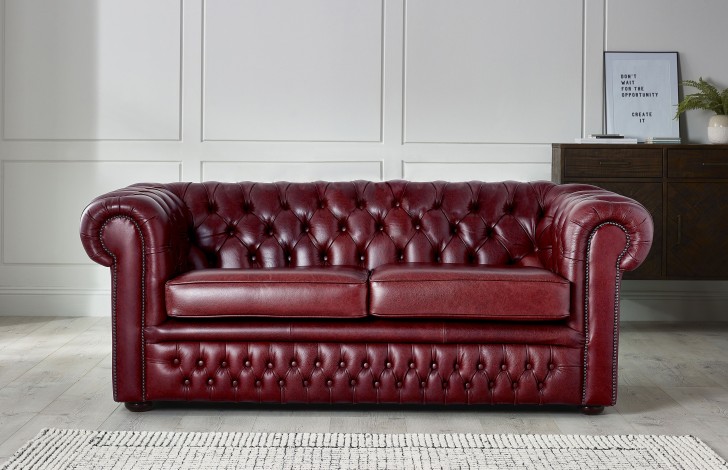
Now · The Chesterfield Company
Claridge ChesterfieldDescribed by its maker as based on the original Chesterfield design: deep-buttoned leather on a solid beech frame with serpentine springs and bun feet — the Victorian outline, not the Victorian insides.
See the Claridge →Then · 1860–80
Buttoned throughoutAlbert Bentley’s upholsterer’s models: crimson damask deep-buttoned on every surface, a demonstration of days of hand work.

Now · The English Sofa Company
St Dunstan handmade ChesterfieldHand-buttoned in the same diamond pattern; the buttoning is still the slowest part of the job.
See the St Dunstan →Then · c. 1845–60
The high padded backSpoon-backs and cartouche-backs rose behind the sitter, sprung and stuffed to support the whole spine.
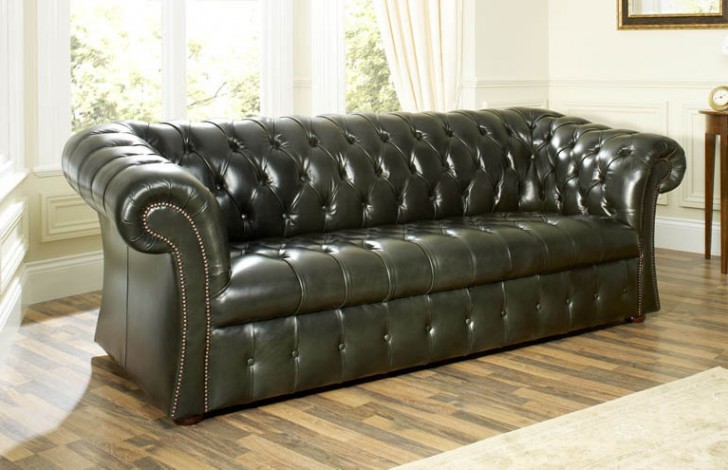
Now · The Chesterfield Company
Coniston high-back ChesterfieldThe Chesterfield outline with the back raised — the spoon-back’s support on a sofa frame.
See the Coniston →Then · c. 1860
The spoon-back chairThe Museum of the Home’s carved mahogany spoon-back on castors, deep-buttoned, low and sprung.

Now · The English Sofa Company
Oliver spoon-back chairA buttoned spoon-back on a show-wood frame — the Victorian drawing-room chair in its modern descendant.
See the Oliver →Then · c. 1855–1901
The Howard easy chairFully upholstered, a loose squab on a sprung seat, short turned legs: comfort from the stuffing, not the frame. Neither brand makes a Howard-named chair.

Now · The English Sofa Company
Balmoral cushion Chesterfield chairThe nearest form: a loose seat cushion over a sprung platform inside a buttoned Chesterfield shell.
See the Balmoral →Then · 1840s–1900
Dark hide for gaslit roomsLeather that wiped clean of soot and smoke, in browns and deep reds that hid the dirt.
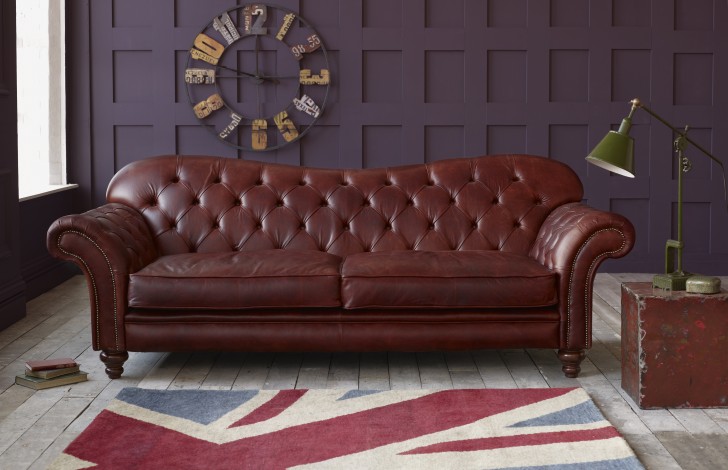
Now · The Chesterfield Company
Arundel vintage brown leather sofaA hand-finished brown hide on a Chesterfield frame; the grades run from corrected full-grain to aniline.
See the Arundel →Modern pieces are shown for comparison only and are descendants, not reproductions. Their frames are solid beech; seats are sprung with serpentine springs rather than coils; cushions are foam, fibre or feather-wrapped rather than horsehair. No Victorian maker’s pattern is being copied.
Common misconceptions
“The Earl of Chesterfield invented the Chesterfield sofa.” No museum or collection record cited on this page connects the fourth Earl (1694–1773), or any later Earl, to a sofa. The construction of the Chesterfield is Victorian; the story of its commission is an unverified trade tradition.
“Victorian sofas were stuffed with springs from the start.” Springs were patented in 1828 and were not standard in domestic seating until the 1830s; the V&A dates their near-universal use in drawing rooms to about 1850. Earlier Victorian pieces and cheaper ones remained stuffed only.
“Buttoning is purely decorative.” It was first a way of holding loose horsehair in place, as the buttoning pattern preserved in the horsehair pads of the V&A’s Belter sofa shows. The display value followed from the labour it required.
“Morris & Co made heavy Victorian upholstery.” The firm’s seating was the reaction against it: rush-seated Sussex chairs at under ten shillings and an adjustable-back chair with loose cushions on a turned frame, without a spring in the woodwork.
Questions people ask
When did coil springs first appear in sofas?
Coil springs were patented for seating in 1828 and became standard in British domestic furniture during the 1830s. The V&A records that spiral springs had been used for specialised furniture in the late eighteenth century, but that by 1850 almost every drawing-room chair or settee was sprung. The springs deepened the seat and lowered the visible wood.
What is the difference between a Chesterfield and an ordinary Victorian sofa?
A Chesterfield has arms at the same height as its back, a low sprung seat and a deep-buttoned cover, usually leather, with no show-wood above the feet. Other Victorian sofas kept a raised back, scrolled or lower arms, and often a carved or ebonised frame showing around the upholstery, with fabric rather than hide.
Did the Earl of Chesterfield really commission the first Chesterfield sofa?
There is no evidence for it in any museum or collection record cited on this page. English Heritage and the V&A document the fourth Earl (1694–1773), his letters and his furniture, but not a sofa. The construction of the Chesterfield is Victorian, and the story of its commission should be treated as an unverified tradition.
How were Victorian sofas made?
Webbing was stretched across a hardwood frame; coil springs were sewn to it and lashed down; a coarse cloth covered the springs; horsehair was built up and stitched to a firm edge; wadding smoothed it; and the top cover was pulled through and buttoned. The V&A’s parlour chair of about 1845 shows six copper-coated steel springs under stitched horsehair.
Why were Victorian sofas deep-buttoned?
Buttoning held loose horsehair stuffing in place by dividing it into cells that could not shift, and it displayed the cost of the upholsterer’s labour. The Museum of the Home says the technique conveyed both comfort and luxury; the V&A found an original buttoning pattern preserved in the horsehair pads of an 1850s sofa.
What is a spoon-back chair?
A Victorian upholstered armchair whose padded back curves like the bowl of a spoon to meet the sitter’s spine, usually on a carved walnut or mahogany frame with castors. The Museum of the Home’s example of about 1860 is deep-buttoned over a sprung seat; balloon-back chairs were its plainer, hoop-backed dining and bedroom relatives.
Who were Howard & Sons?
London upholsterers, trading from 1820 and from 1847 at Berners Street, whose fully upholstered easy chairs became the standard of Victorian comfort. George Howard patented “Elastic Seats” in 1866; the firm received a royal warrant for upholstered goods from Edward VII in 1901, and the Furniture History Society identifies a sofa of about 1855 at Sudbury Hall as its earliest intact upholstery.
Are Victorian sofas comfortable, and are they worth restoring?
A well-made sprung and hair-stuffed Victorian sofa is firm, supportive and low, and can be re-upholstered repeatedly because the hardwood frame outlasts the filling. Original upholstery is rare and historically valuable, so a piece that retains it should be assessed before any work. Replacement fillings and covers are normal on surviving examples.
Why are Victorian interiors and sofas so dark?
Gas lighting, in middle-class homes from the 1840s, blackened walls and ceilings and stripped gilding from frames, according to English Heritage. Deep reds, greens and browns hid soot, leather wiped clean, and loose covers and antimacassars protected the good cloth, so dark colours were practical as well as fashionable.
What modern sofa is closest to a Victorian Chesterfield?
A deep-buttoned leather Chesterfield with arms level with the back, a low seat and bun feet, made today on a solid beech frame with serpentine springs and foam, fibre or feather-wrapped fillings. Such pieces are descendants of the Victorian form rather than reproductions, since the coil-sprung, horsehair construction is no longer used.
Sources
- Museum of the Home, spoon-back armchair, c. 1860, 29/1994 — collections.museumofthehome.org.uk/object31004
- Museum of the Home, Rooms Through Time: A Drawing Room in 1830; A Townhouse in 1878 — museumofthehome.org.uk
- Museum of the Home, Comfort gallery; Creating a period room — museumofthehome.org.uk
- V&A, settee, ebonised beech and walnut, c. 1845–60, W.111-1978 (on the introduction of springs) — collections.vam.ac.uk/item/O372219
- V&A, walnut parlour chair with original sprung upholstery, c. 1845, W.93-1921 — collections.vam.ac.uk/item/O15948
- V&A, armchair by Henry Eyles shown at the Great Exhibition, 1851, CIRC.35:1-1958 — collections.vam.ac.uk/item/O18955
- V&A, miniature seating furniture by Albert Bentley, 1860–80, W.13-1934 — collections.vam.ac.uk/item/O1119985
- V&A, sofa by John Henry Belter, c. 1856, W.22-1983 — collections.vam.ac.uk/item/O59258
- V&A, balloon-back side chair, c. 1855, CIRC.235-1960; child’s balloon-back chair, 1845–55, CIRC.155-1950 — collections.vam.ac.uk/item/O136629
- V&A, child’s chaise longue in horsehair, 1851, W.19-1927 — collections.vam.ac.uk/item/O1131697
- V&A, bentwood chaise longue, 1860–70, W.21-1970; beaded ottoman cover, c. 1860, T.90-1939 — collections.vam.ac.uk/item/O314910
- V&A, “False Principle no. 16”, printed cotton, c. 1850, T.6-1933 — collections.vam.ac.uk/item/O15946
- V&A, Sussex chair, Morris & Co, 1870–90, CIRC.288-1960 — collections.vam.ac.uk/item/O7883
- V&A, adjustable-back chair, Morris & Co, 1870–90, CIRC.250-1961; oak example 1883–1900, CIRC.642-1962 — collections.vam.ac.uk/item/O9236
- V&A, bust of the 4th Earl of Chesterfield by Roubiliac, c. 1745, A.17-1959; The Great Exhibition of 1851 (article) — collections.vam.ac.uk/item/O127094
- V&A, Arts and Crafts: an introduction; William Morris collection page; A short history of plywood — vam.ac.uk
- Science Museum Group, veneer cut by machinery patented by Samuel Bentham, 1791–93, 1859-2 — collection.sciencemuseumgroup.org.uk
- Furniture History Society, BIFMO: Howard, John; Howard and Sons (1820–1925) — bifmo.furniturehistorysociety.org
- National Trust Collections, Chesterfield, Croft Castle, NT 537519 — nationaltrustcollections.org.uk/object/537519
- English Heritage, Lord Chesterfield at Ranger’s House; The illuminating history of lighting — english-heritage.org.uk