Home · Origins to 1700
c. 3000 BC – 1700
Before the sofa: couches, benches and the first fixed upholstery
The sofa is a seventeenth-century invention with a three-thousand-year prehistory. This period follows the couch from the Nile to a Kent country house, and ends where fixed upholstery — stuffing nailed over a frame — makes the modern sofa possible.
In brief. Before 1700 there was no sofa in the modern sense: people reclined on wooden couches with loose cushions, then sat on benches and stools. Fixed upholstery — stuffing nailed permanently over a frame — first appears in England around 1620–30, and the Knole couch of c. 1635–40 is one of the earliest surviving upholstered couches. Seats were stuffed with feathers, grass or horsehair over webbing; there were no springs.
- Earliest surviving furniture
- c. 3000 BCEarly Dynastic Egypt; dry tombs preserved the wood
- Fixed upholstery begins
- c. 1620–30A feather cushion nailed to a London backstool
- The Knole sofa
- c. 1635–40Beech frame, crimson velvet, iron ratchets
- Springs in the seat
- NoneStuffing only, until the 19th century
- The word “sofa”
- c. 1700Arabic ṣuffa, via Romance languages
Couches before there were sofas
For most of history the ordinary person did not sit on anything upholstered. In Egypt, most people slept on mats laid on the ground, and a chair was reserved for someone in a higher position; furniture survives from the Early Dynastic period (around 3000 BC) and the New Kingdom (around 1550–1069 BC) only because the tombs were so dry. What survives shows how sophisticated the joinery already was. The chair made for Hatnefer, a woman of the court around 1490 BC, is boxwood, cypress and ebony, its joints cut as mortise and tenon and locked with pegs, its seat woven from linen cord — a construction still recognisable in a modern webbed seat. A bed from the tomb of Ramesses IX, three centuries later, stands on hardwood legs carved as bull’s legs, with gold-sheet cobras fixed by gold and silver nails and inlays of ebony; the British Museum notes that feline legs replaced bull legs as the fashion of the period.
The Greeks turned the couch into a social instrument. At the symposium, an aristocratic male drinking party, guests reclined one or two to a couch, and the room built for it — the andron — was laid out for seven to fifteen couches with cushions and low tables. The kline was a single bed set against the wall, each with its own small table and often a step stool; diners leant on the left elbow and ate with the right hand. Elaborate examples carried carved fittings: a Hellenistic couch-end in the British Museum, from 200–100 BC, keeps its ivory inset of a satyr’s head.
Rome inherited the habit and gave us the triclinium: a dining room with three broad couches, each seating three, arranged in a U. The couches were usually wood, but opulent versions had fittings of ivory and bronze, angled sharply upward to lift the diner above the table. A first- or second-century couch and footstool of wood, bone and glass in the Metropolitan Museum was reassembled from fragments, possibly from the residence of the emperor Lucius Verus; bronze headrest fittings from Campania, dated AD 20–60, are inlaid with silver and copper and finished with mule heads and satyr busts. Unlike Greece, respectable Roman women were permitted to recline with the men. The reclining habit lasted in the West into the sixth century — and then, for a thousand years, it stopped.
Benches, forms and the loose cushion, 1100–1600
Medieval and Tudor England sat on stools, benches and forms. The V&A’s furniture curators describe the two common builds: a staked stool, made by boring holes into a solid plank seat and wedging the legs into them, and a boarded stool of straight boards pegged and braced together. A form was a long armless bench, free-standing or fixed to the wall, sometimes with a back panel; an English example of 1500–50 survives in the museum. A French bench of the late fifteenth century, the banc tournis, had a movable back rail that pivoted over so its sitters could face either the fire or the room — arguably the first convertible seat.
Comfort came from textiles laid on top, not built in. Even a great household usually had one armchair, for its most important person, while everyone else sat lower on stools, benches or cushions. Thrones could be dressed with luxury textiles, but as the V&A puts it they were for looking important, not lounging. A French armchair of about 1515 in the same collection includes a storage box within the seat — the chest-as-seat that would persist in the settle for centuries. The folding X-frame chair, seen in an Italian example of about 1550, descends directly from the campaign stools of Roman generals. As late as 1630, the Museum of the Home’s reconstruction of a hall shows the household still eating together at an oak table on stools.
The birth of fixed upholstery, 1600–1650
The change that makes a sofa possible is small and easy to miss. Some time around 1620–30 a London chair-maker took a fully formed cushion — a ticking case filled with feathers — and nailed it down to the frame of a backstool. The V&A holds that chair and describes it as the beginning of the practice of fixed upholstery. The backstool itself had evolved by adding a back to a stool; it was made in sets, on walnut and beech frames with pegged mortise-and-tenon joints, finished with decorative brass nails over structural iron ones. Between about 1615 and 1670 it was by far the commonest type of relatively comfortable chair in England; “back stool” was the period’s own name for it, and the collectors’ term “farthingale chair” came later.
The trade that did this work was the upholder — the word survives in the Furniture History Society’s dictionary of British makers, and the V&A catalogues the chair made for Bishop Juxon in 1661 under the upholsterer John Casbert. For royal furniture the orders came through the Great Wardrobe, the department that supplied the court, and it is through that route that the most famous early sofa in Britain reached the house where it still sits.
Milestone · c. 1635–40
The Knole sofa
In the Leicester Gallery at Knole, Kent, stands a beech-framed couch covered in crimson stamped silk velvet, fixed with brass dome-headed studs and hung with fringe of gold and silver thread. Its padded ends can be inclined or raised on an iron ratchet mechanism — the drop arm that would be reproduced, in the National Trust’s words, in tens of thousands from Victorian times to the present. It was probably made in London by suppliers to the Great Wardrobe, and most likely came to Knole as a perquisite of Charles Sackville, 6th Earl of Dorset, Lord Chamberlain to William III, who brought royal furniture to the house in 1701. The Trust calls it one of the earliest surviving examples of an upholstered couch — and, more properly, a state couch: a ceremonial seat on which a queen could receive guests beneath a canopy, not a place to slump.
It has an older cousin. The Hardwick Hall “Couch of State” of about 1625–40 is oak and elm with sloping panelled ends, painted red to simulate red velvet and originally covered in silk damask, and a 1775 inventory shows it under a canopy. The X-frame Chair of State at Knole, of about 1620, has a stuffed seat, two cushions, deep fringe and large gilt nails. Together they show the grammar of the earliest fixed upholstery: stuffing nailed over a frame, a show cover of the most expensive textile the owner could afford, and a row of studs to hide the fixing and announce the cost.
Leather, cane and the first settees, 1650–1700
By the Restoration the method had settled. The V&A’s leather backstools of 1640–60 and 1660–1700 show the standard build: webbing and a base cloth nailed to the frame, a padding of grass or horsehair — sometimes stitched through to keep it from forming lumps — and a top cover of leather nailed around the seat rails. There are no springs; there would be none for another century and a half. Leather was the cover for use rather than display, on a chair that would withstand regular sitting, possibly at the dining table.
Fashion moved in two directions at once. At the top, walnut and silk: a day-bed at Knole of about 1670–85 has eight scroll legs and a cover of silk brocade shot with silver thread. Below it, cane. From the 1680s caned chairs became extremely popular because they were much cheaper than upholstered ones; a caned walnut day-bed of 1680–1700 in the V&A was used with a loose squab cushion, and the Museum of the Home records the cane chair as the most common chair in middle-class homes from the 1690s to the 1720s. The loose squab over a resilient base is an idea the sofa never abandoned.
The decade also produced the earliest settee in the V&A’s collection with its upholstery never removed: a piece of 1690–1700 made for Thomas, Lord Coningsby, of Hampton Court in Herefordshire. Its beech frame stands on ebonised walnut legs turned as fluted columns and joined by curving cross-stretchers; its cover is wool-and-silk canvaswork with a back of harrateen, trimmed with braid and bell fringe. It is a chair that has become long enough for two — which is, in the end, the whole definition.
And the name arrived. Sofa is an Arabic loan-word (ṣuffa, a raised platform with cushions) that made its way into English through the Romance languages; the National Trust places its first English use around 1700, the same decade in which the Knole couch came to Kent.
Materials: what went where, and why
| Period | Frame | Filling | Cover | Construction |
|---|---|---|---|---|
| Egypt, New Kingdom | Boxwood, cypress, ebony, hardwoods | Mats; cushions not recorded in museum records | Woven linen cord seat | Pegged mortise-and-tenon; gold and silver nails; inlay |
| Greece and Rome | Wood | Cushions and mattresses | Textiles (type not specified) | Bronze, ivory and bone fittings; raised fulcrum headrest |
| Medieval to 1600 | Oak | Loose cushions only | Luxury textiles on thrones | Staked, boarded or joined; box seats |
| c. 1620–60 | Walnut, beech, oak | Feather-filled ticking; grass or horsehair | Wool, silk, leather, Turkey work | Cushion nailed to frame; webbing and base cloth; brass over iron nails |
| Knole, c. 1635–40 | Beech | Padded (fill not recorded) | Stamped silk velvet; wool on the back | Brass dome studs; fringe; iron ratchet arms |
| 1670–1700 | Walnut, beech | Stitched stuffing; loose squab | Silk brocade, canvaswork, harrateen, leather, cane | Nailed stuffed-over; no springs |
Leather or fabric?
The choice was already the one we make today, for the same reasons. Leather meant use: the V&A describes its leather backstool as made for use rather than display, tough enough for regular sitting. Turkey work — a knotted-and-cut wool pile made in England in imitation of Turkish carpets — was sold as matching sets of chair covers, a hard-wearing middle option; a backstool cover dated 1649 survives in the V&A, and the Royal Collection holds a chair in the same material. Velvet, silk and metal thread were for royal and state furniture, supplied through the Great Wardrobe to display the wealth and status of the owner — so much so that Hardwick’s oak couch was simply painted red to look like velvet. Cane was the cheap and light answer, softened by a loose cushion. Only the horsehair-over-webbing seat, nailed and studded, cut across all of them.
What survives in a sofa made today
Six ideas from before 1700 are still in production. The comparisons below pair each with a piece made in England today; they are there to make the lineage visible, not to suggest the modern pieces are reproductions.
Then · c. 1635–40
The ratcheted drop armThe Knole couch’s padded ends incline on iron ratchets and are tied to the back with cords — the first adjustable sofa arm.
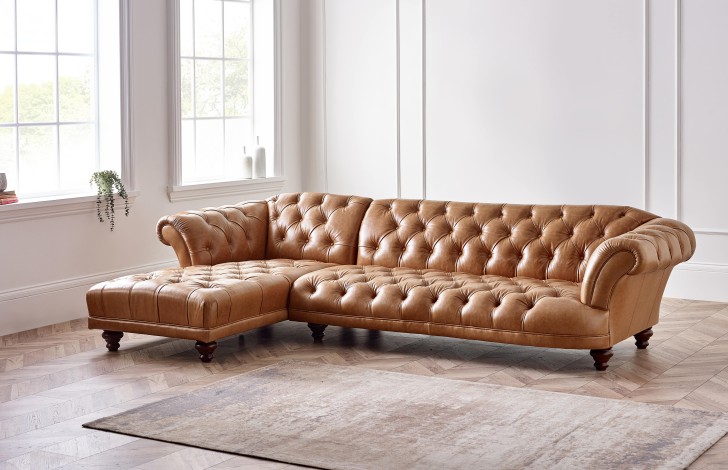
Now · The Chesterfield Company
Lyme chaise sofaThe modern descendant is the open end: one arm dropped away entirely so the seat runs into a chaise.
See the Lyme chaise →Then · 1620–1700
The nailed show cover and stud lineLeather or velvet nailed around the rails, the fixings hidden under a row of brass dome-headed studs.

Now · The English Sofa Company
Arlington studded leather sofaA studded scroll arm does the same job: the stud row still marks where cover meets frame.
See the Arlington →Then · 1670–1700
The day-bedWalnut day-beds at Knole and in the V&A: one raised end, a long seat, a loose squab to lie on.

Now · The English Sofa Company
Abbey chaise longueThe single-ended reclining seat is the day-bed with its cushion built in.
See the Abbey chaise →Then · 1680s
The loose squab on a resilient baseCane seats were used with a loose cushion — soft on top, sprung by the cane beneath.
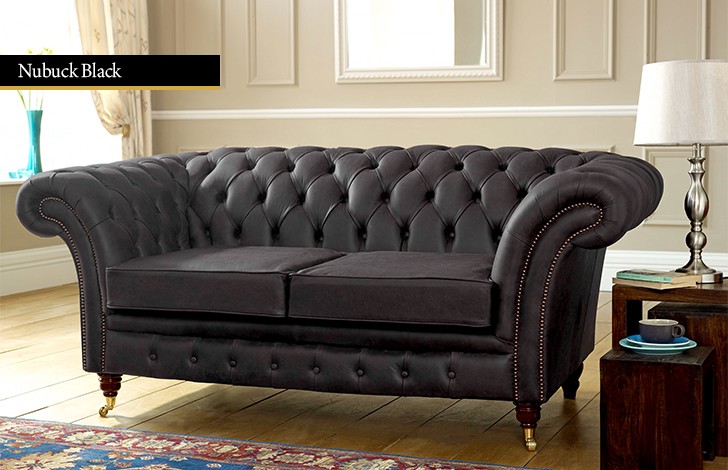
Now · The Chesterfield Company
Blenheim cushioned ChesterfieldLoose seat cushions over a serpentine-sprung platform: the same two-layer idea.
See the Blenheim →Then · 1640–1700
Leather for use, not displayThe Restoration leather backstool: webbing, hair stuffing and a hide cover nailed on, built to be sat in every day.
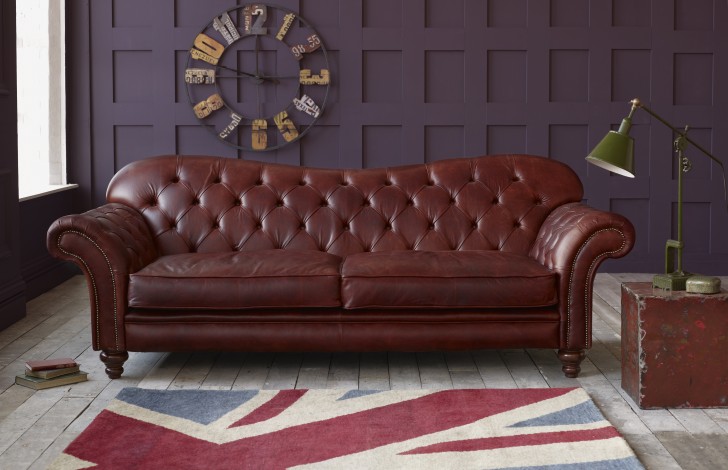
Now · The Chesterfield Company
Leather sofasHide is still the cover chosen for wear; the grades on offer run from corrected full grain to aniline.
See leather sofas →Then · 1649
Velvet and pile for statusStamped silk velvet at Knole; knotted Turkey-work pile on a dated backstool cover of 1649.

Now · The English Sofa Company
Calvert velvet ChesterfieldVelvet on a scroll-armed frame — the state-couch cover on a domestic sofa.
See the Calvert in velvet →Modern pieces are shown for comparison only. Their frames are solid beech; seats are sprung with serpentine springs and filled with foam or fibre — none of which existed before 1700, which is rather the point of the next seven periods.
Common misconceptions
“The Knole is the first sofa.” It is one of the earliest surviving upholstered couches, but the National Trust is careful to call it a state couch — a ceremonial seat — and the V&A’s nailed-cushion backstool of about 1620–30 predates it as the first fixed upholstery.
“Tudor chairs were upholstered.” Cushions, yes; fixed upholstery, no. The earliest museum evidence in England is c. 1620–30. Treat any claim of sixteenth-century fixed upholstery with caution.
“Old sofas were sprung.” None of the pre-1700 pieces in the collections cited here has springs; they were stuffed with feathers, grass or horsehair over webbing. Springs arrive in the nineteenth century.
“Farthingale chair” was the period name. It is a later collectors’ label; the seventeenth century said “back stool”.
Questions people ask
When was the first sofa made?
Fixed-upholstered couches appear in England around 1625–40. The Knole sofa of c. 1635–40 is described by the National Trust as one of the earliest surviving examples of an upholstered couch, and the V&A’s nailed-cushion backstool of c. 1620–30 is the earliest fixed upholstery in its collection.
Is the Knole sofa really a sofa?
Not in the modern sense. The National Trust calls it more properly a state couch: a ceremonial seat, probably used beneath a canopy for receiving guests, rather than a piece of domestic comfort.
Where does the word “sofa” come from?
From Arabic, reaching English through the Romance languages; the National Trust places its first English use around 1700. Before that the English words were couch, day-bed, settle and settee.
What did ancient Egyptians sit and sleep on?
Mostly mats on the ground. The elite had wooden beds and chairs with animal-form legs and seats woven from linen cord, joined with pegged mortise-and-tenon joints.
Why did the Greeks and Romans lie down to eat?
Reclining on a couch was an elite ritual. In Greece the symposium was a men-only gathering with one or two to a couch; in Rome the triclinium held three couches of three diners each, and respectable women joined the men.
Were early sofas sprung?
No. Seats before 1700 were stuffed with feathers, grass or horsehair over webbing and nailed down. Springs do not appear in any of the collection records cited on this page; they belong to the nineteenth century.
What is the difference between a couch, a settee, a day-bed and a sofa?
In the seventeenth century a couch or day-bed was a long seat with one raised end for reclining; a settee was a chair widened for two or more, with a back and arms; and “sofa” was a new word for an upholstered version of either. Today the terms are used interchangeably, but the raised single end still marks a chaise or day-bed from a sofa.
How was a seventeenth-century upholstered chair made?
A walnut or beech frame was joined with pegged mortise-and-tenon joints. Strips of webbing were nailed across the seat, a base cloth laid over them, and a stuffing of grass, feathers or horsehair — sometimes stitched through to stop it lumping — was built up on top. The show cover of leather, Turkey work or velvet was nailed round the rails and the fixings hidden under brass-headed studs.
What modern sofa is closest to a seventeenth-century state couch?
Nothing made today is a reproduction of a state couch, but the same ideas survive: a studded show cover on a scroll-arm sofa, a loose seat cushion over a sprung platform, a single-ended chaise in place of the day-bed, and leather chosen for wear rather than display. The comparison cards on this page pair each idea with a piece made in England now.
Sources
- National Trust Collections, The Knole Sofa, NT 129442 — nationaltrustcollections.org.uk/object/129442
- National Trust, Knole’s furniture collection — nationaltrust.org.uk
- National Trust Collections, Couch of State, Hardwick Hall, NT 1127775 — nationaltrustcollections.org.uk/object/1127775
- National Trust Collections, Chair of State, Knole, NT 129463 — nationaltrustcollections.org.uk/object/129463
- National Trust Collections, day-bed, Knole, NT 129532 — nationaltrustcollections.org.uk/object/129532
- V&A, backstool with nailed feather cushion, W.1-1912 — collections.vam.ac.uk/item/O131714
- V&A, backstool with Turkey-work cover dated 1649, 428-1896 — collections.vam.ac.uk/item/O60672
- V&A, leather backstool 1640–60, W.9-1923 — collections.vam.ac.uk/item/O167596
- V&A, leather backstool 1660–1700, CIRC.216-1923 — collections.vam.ac.uk/item/O79080
- V&A, caned day-bed 1680–1700, W.43-1925 — collections.vam.ac.uk/item/O370260
- V&A, settee made for Lord Coningsby 1690–1700, W.15-1945 — collections.vam.ac.uk/item/O9899
- V&A, X-frame armchair, Italy c. 1550, 7196-1860 — collections.vam.ac.uk/item/O122666
- V&A blog, “Where to put your lowly medieval bottom” — vam.ac.uk
- V&A blog, “The real Game of Thrones: medieval seats of power” — vam.ac.uk
- Museum of the Home, Rooms Through Time: a hall in 1630; a parlour in 1695 — museumofthehome.org.uk
- British Museum, bed of Ramesses IX, EA21574 — britishmuseum.org
- British Museum, ivory couch-end inset, 1873,0820.661; bronze fulcrum fittings, 1784,0131.4.1 — britishmuseum.org
- The Metropolitan Museum of Art, chair of Hatnefer, 36.3.152 — metmuseum.org
- The Metropolitan Museum of Art, Roman couch and footstool, 17.190.2076 — metmuseum.org
- The Metropolitan Museum of Art, essays: The Symposium in Ancient Greece; The Roman Banquet — metmuseum.org
- The Metropolitan Museum of Art, Art of the Islamic World: frequently asked questions (origin of “sofa”) — metmuseum.org
- Getty Museum, Reclining and dining in ancient Greece and Rome — getty.edu
- UCL, Digital Egypt for Universities: furniture — ucl.ac.uk
- Royal Collection Trust, Turkey-work chair, RCIN 28153 — rct.uk
- Furniture History Society, British and Irish Furniture Makers Online (“upholder”) — bifmo.furniturehistorysociety.org