Home · Interwar & Art Deco
1918 – 1939
Interwar and Art Deco: the club sofa, chrome, latex and the front-room suite
Two decades that made the modern sofa cheap, low and manufactured. Art Deco gave it a line, the Bauhaus gave it a steel frame, Dunlop gave it a foam cushion and hire purchase gave it a market — before the Board of Trade took the whole industry in hand.
In brief. Between the wars the British sofa dropped its height, rounded its arms and moved into the suburban front room as one third of a three-piece suite, usually bought on hire purchase. Two new materials arrived underneath the cover — chrome-plated tubular steel for the frame, from 1925, and latex foam for the cushion, developed by Dunlop in the same decade — while leathercloth and moquette replaced hide and velvet for the mass market. The period ended with the government taking control of furniture altogether: the Utility scheme of 1942–52, whose plain, standardised easy chairs were the last word of the interwar years.
- Art Deco named
- 1925The Paris Exposition Internationale des Arts Décoratifs
- Tubular steel chair
- 1925–26Marcel Breuer’s B3 at the Bauhaus; PEL follows in Britain, 1931
- Latex foam cushioning
- InterwarDeveloped by Dunlop, sold under the Dunlopillo name
- Hire purchase
- 1938Some five million families paying for furniture by instalments
- Utility furniture
- 1942–52Board of Trade scheme; CC41 mark; Gordon Russell’s panel
What did a sofa look like after the First World War?
The sofa of the 1920s was lower, deeper and rounder than anything the Edwardians had sat on. The upright stuffed-over seat of 1900 gave way to the club shape: a squat frame, arms rolled into a fat cylinder or squared into a slab, a back that curved into the arms without a break, and loose seat cushions on a sprung platform. The name came from the gentleman’s club, but the form was made for a smaller room than any club possessed. A typical survivor in the Museum of the Home is an armchair of 1930–40 by the Buoyant Patent Upholstery Company of Nottingham, one of a three-piece suite, with rounded arms and back, castors, and a cotton cover in an abstract pattern of greens, brown and beige; the maker’s labels are still fixed to its base. It is not a grand object, and that is why it matters: it is what most people bought.
Above the suite trade stood the reforming shops. Heal & Son of Tottenham Court Road, under Ambrose Heal — chairman from 1913, knighted in 1933 — sold well-made furniture in plain woods; the V&A’s Heal armchair of 1928–29 is limed oak with a leather seat, made as the companion to a desk. Below it came industrial substitutes that looked like craft. W. Lusty & Sons bought the rights in 1921 to the American Lloyd Loom method of weaving twisted paper fibre, and their model 464 armchair of November 1930, black with gold and a stepped pattern on the back, shows a production-line material borrowing the Moderne look; the V&A notes that Lloyd Loom replaced wicker, which was dearer and less durable, and was made in vast quantities into the 1960s.
What was Art Deco, and how did it reach British sofas?
Art Deco takes its name from the Paris exhibition of 1925, the Exposition Internationale des Arts Décoratifs et Industriels Modernes; the V&A describes the style as running from the boom of the 1920s to the bust of the 1930s, drawing on old traditions while celebrating the modern, mechanised world. In France it was a luxury art — Emile-Jacques Ruhlmann called his richest work his “precious pieces”, in exotic woods, ivory and sharkskin. In Britain it was quieter and more commercial, and in upholstery it meant a low horizontal line, a stepped or curved silhouette, and pale plain covers set off by strong accent colours.
Three names carried it into the London drawing room. Betty Joel, born in Hong Kong in 1896, began designing for her own house after arriving in England in 1918, built a factory at Hayling Island under the “Token” name and moved production to Portsmouth in 1929, keeping a Knightsbridge house as showroom. The V&A holds a suite she made in 1929 for a Harley Street consulting room in Queensland silky oak, and sums up her manner as the rich materials and clean lines of French Art Deco joined to the functionalism and craftsmanship of the Arts and Crafts movement. Syrie Maugham ran a decorating shop from 1922, opening in Grosvenor Square in 1924, and became famous for rooms in shades of white — mirrors, antiques and modern fabrics against white finishes; her mirrored screen of 1935 in the V&A was made for her own house. Waring & Gillow, whose Oxford Street emporium had opened in 1906, staged an interior-decoration exhibition of Frank Brangwyn’s designs in 1930, went into receivership in 1931 and was refloated the next year — a reminder that the style arrived with the slump.
The country-house version survives at Coleton Fishacre in Devon, finished in 1926 for Rupert and Dorothy D’Oyly Carte to Oswald Milne’s design, with pale rooms, strong accent colours and a saloon carpet by Marion Dorn. The popular version was the cinema. The Odeon at Sutton Coldfield, built 1935–36 by J. Cecil Clavering of Harry Weedon’s office, is listed by Historic England as the first purpose-built Odeon in the mature house style, with low curved balustrades in the foyer and “go-faster” streamlined mouldings; Oscar Deutsch spent on the exterior and kept the interior simple. The curved, banded, upholstered look people came to call “Odeon style” was learnt in those foyers and taken home.
When did tubular steel furniture arrive in Britain?
Tubular steel furniture was invented at the Bauhaus in 1925–26 and reached British production in 1931. Marcel Breuer, master of the Bauhaus furniture workshop from 1925, took the idea from his bicycle frame; his club chair, model B3, is nickel-plated steel tube with strips of cotton canvas stretched for seat, back and arms — a club armchair reduced to its outline. The V&A holds one made in 1927–28 and calls it the first tubular steel chair and, for many, the most important piece of furniture of the twentieth century; it adds that although the chair stood for mass production, most examples were hand-built in small numbers. Mart Stam’s cantilever of 1926 removed the back legs altogether.
Milestone · 1931
Tubular steel and the machine aesthetic
Practical Equipment Limited — PEL — was founded in 1931 as a subsidiary of the steel-tube makers Accles & Pollock at Oldbury, near Birmingham, by manufacturers who had seen tubular steel furniture in the Strand Palace Hotel. Its RP6 stacking chair, designed by the Austrian Bruno Pollak in 1931–32, is a bent steel tube with the back legs rising in an inverted U to carry the backrest, and a canvas seat and back bolted on; the BBC bought large numbers for Broadcasting House and its studios. The Museum of the Home’s example is grey-enamelled with red canvas; the V&A’s, made 1934–39, carries the patent plate. A dispute over that patent ended in late 1934 when PEL bought it from Pollak and collected royalties from licensees such as Cox & Co until 1951. The V&A lists twenty-three PEL objects — chairs, settees, armchairs, tables and stands in chrome steel — with designs credited to Oliver Bernard, Wells Coates and Breuer himself. The settees were a chrome tube outline carrying sprung, leather- or fabric-covered pads: the machine aesthetic applied to the club shape.
Why did plywood follow steel?
British taste cooled on chrome almost as soon as it warmed to it, and bent plywood took its place in the progressive home. The V&A’s account of Breuer’s Long Chair of 1936, made by Isokon, says the move to plywood suited a British modernism that preferred the soft curves and warm appearance of wood to the harsher look of metal. Isokon, founded by Jack Pritchard, is described by the museum as probably the most forward-thinking British furniture maker of the 1930s; the Long Chair evolved from Breuer’s aluminium chair of 1932–33 under the influence of Alvar Aalto, its seat sent from Estonia and fixed to a London-made frame, priced at over six pounds, with upholstery to the buyer’s choice. Gerald Summers’s armchair of 1934, made by his firm Makers of Simple Furniture, went further: one sheet of thirteen-ply birch, cut with four straight lines, glued and pressed in a wooden mould for eight hours, with no bracing at all. About 120 were made before the company closed in 1940 for want of materials. None of these is a sofa, but together they set the low, cantilevered, cushion-on-a-frame idea that the upholstered sofa would absorb after 1945.
What were 1930s sofas stuffed with?
For most of the period, the answer was still horsehair and coil springs — but their replacements were born here. The 1920s suite seat was a coil-sprung platform, the springs lashed to webbing and covered in hessian, with hair or fibre stitched over and a top cover tacked to the frame; the loose cushions on better suites were spring interiors in ticking, a miniature mattress. Rubberised hair — curled hair bonded with latex into a sheet that kept its loft without stitching — offered a quicker, more even pad. Then the rubber came without the hair.
Milestone · interwar, sold as Dunlopillo
Latex foam cushions
The Science Museum Group’s record of the Dunlop Rubber Company, grown from the pneumatic tyre business of 1888, states plainly that the inter-war period saw the development of latex foam cushioning, sold by the subsidiary Dunlopillo. Whipped natural latex, poured into a mould and cured, gave a cushion that was open-celled, resilient and shaped to the seat in one piece: no springs, no stuffing, no stitching and — the point for manufacturers — no skilled upholsterer to fill it. The launch date usually quoted for the trade name is 1929; the museum record does not give it, so we offer it only as the accepted date. What is certain is the consequence: from this decade the sofa cushion could be a manufactured block rather than a filled bag, and the whole post-war industry of foam seating descends from it.
Springs changed too, though the change is harder to document from museum objects. The trade adopted tension springs — long, close-coiled steel springs stretched horizontally across the seat frame and clipped at each end — to give a resilient base a fraction of the depth of a coil-sprung platform, which is what let the seat sit so low; and unit springing, coils pre-assembled on wire frames, could be dropped into a seat as a single component. Gordon Russell’s Utility working drawings of 1943–52 in the V&A include diagrams of spring-unit components, which shows the unit was standard by the war. The zigzag “no-sag” spring that carries most modern sofas belongs to the same family, but we have found no dated British object to fix its arrival and treat it as post-war in practice.
Who bought the three-piece suite, and how?
The three-piece suite was bought by the new suburban owner-occupier, and mostly on credit. Historic England’s guide to suburban housing names the forces behind the interwar building boom — an expanding middle class, the increasing availability of mortgages and the political promotion of home-ownership — and the speculative semi with gables, bay windows and so-called half-timbering that resulted. Its front room was for display, used on Sundays and for visitors, and the suite of settee and two armchairs, matched in cover and shape, was its centrepiece: bought as a set, delivered as a set and paid for weekly.
The scale is recorded in Parliament. Introducing the Hire-Purchase Bill to the Lords on 2 June 1938, Lord Amulree said that something like five million families held hire-purchase agreements for furniture alone, that about sixty per cent of British furniture was sold this way, and that the trade ran to roughly £100 million a year. The Bill — steered through the Commons by Ellen Wilkinson, the Member for Jarrow — was aimed at the “snatch-back”, the repossession of goods after almost the whole price had been paid; the debate cited a charwoman who lost all her furniture having paid all but twenty-five shillings. The Act passed that year. It is the first time the sofa appears in British law as an object of consumer protection, and it tells you who was buying: not the client of Betty Joel, but the family in the semi.
Materials: what went where, and why
| Period | Frame | Filling | Cover | Construction |
|---|---|---|---|---|
| 1918–30, suite trade | Beech and birch, softwood rails | Coil springs, hair, fibre; spring-interior cushions | Uncut moquette, cotton prints, leathercloth | Stuffed-over club shape; loose cushions; castors |
| 1925–39, Art Deco showroom | Walnut, oak, silky oak; veneered plinths | Sprung; down or hair cushions | Plain wool, velvet, hide; pale colours | Low horizontal line; stepped or curved silhouette |
| 1925–39, tubular steel | Chrome- or enamel-finished steel tube | Sprung pads; canvas | Canvas, leather, hide, fabric on pads | Bent tube, bolted; cantilever; stacking |
| 1930–40, bent plywood | Laminated and moulded birch | Loose cushion or none | Loose covers to order | Sheet cut, glued and pressed in a mould |
| Interwar onward | As above | Rubberised hair; latex foam (Dunlopillo); spring units | As above | Moulded cushion replaces stuffed bag |
| Utility, 1942–52 | Stained oak and beech; birch plywood | Spring units; specified fillings | Rexine, plain patterned fabric | Approved designs only; CC41 mark; licensed makers |
Leather or fabric?
For the first time the honest answer was neither — or rather, imitations of both. Leathercloth, sold under trade names of which Rexine is the best known, was a cotton fabric coated with nitrocellulose, embossed and coloured to pass for hide; the Science Museum Group describes it as made by ICI’s Leathercloth Division at Hyde in Cheshire and commonly used as an upholstery substitute, durable and easy to clean. It gave the suite trade a “leather” suite at a fabric price, and went on doing so through the war: the Museum of the Home’s Utility dining chairs of 1943–48 have drop-in seats in brown Rexine. Moquette did the same job for velvet. A woven wool pile, its name from the French for carpet, it could be cut for a velvet nap or left uncut in loops for a hard, dirt-hiding surface; the London Transport Museum records that the first London pattern, Lozenge, was woven in 1923 by Firth Furnishings and reflected the Art Deco home furnishing of the day, and that in the 1930s Frank Pick commissioned Enid Marx, Marion Dorn and Paul Nash to replace florals with geometry. The suite in uncut moquette and the bus seat were cut from the same cloth. Real hide stayed at the top of the range, real velvet in the decorator’s white room; below them, for the first time, most people sat on a manufactured surface designed to look like something else.
Coda: what was Utility furniture, 1942–52?
Utility furniture was the government-controlled furniture of the Second World War and after: a fixed range of approved designs, made by licensed firms from specified materials and sold at controlled prices. The V&A records that the Board of Trade set up the scheme in 1941 to ration the production and consumption of furniture, with strict specifications for the dimensions and materials of every piece; timber was one of the scarcest materials, and furniture therefore one of the most tightly controlled classes of goods. The Museum of the Home adds the reasons — demand from people bombed out of their homes, the need to save materials, and the loss of skilled labour to the forces and munitions. Each piece carried the CC41 mark; the museum’s Chiltern-range dining chair of October 1942, designed by Edwin Clinch and Herbert Cutler and made by Moss Partners of Enfield, is stamped with it, and another, from High Wycombe, carries its maker’s licence number, CC41 460.
Milestone · 1942–52
Utility furniture
The scheme’s design panel was chaired by Gordon Russell, the Broadway furniture maker; the V&A holds fifteen of his working drawings for the Advisory Committee on Utility Furniture, covering bedroom, dining-room, kitchen and nursery furniture in wood, metal, cane and willow, with diagrams of joints and spring-unit components, given by the Board of Trade. The easy chair of the range survives in the Museum of the Home: Clinch and Cutler’s open-arm Model 2 of 1943–53, a stained beech and oak frame with brown diamond-patterned upholstery, joined, sprung and covered with nothing spare. Even a child’s chair in the V&A, made 1942–48 of bamboo and wicker to save timber, wears the mark. The museum describes the results as straight-edged, plain and unembellished, form following function and construction, and notes that Utility was seen as an austerity necessity and fell from favour as soon as restrictions ended in 1953. Its legacy was not the look but the method — a specification, a spring unit, a standard cover — which the post-war industry kept when the plainness went.
What survives in a sofa made today
The low line, the rounded arm and the moulded cushion all date from these two decades, and so does buying seating as a set. The comparisons below pair each with a piece made in England today; they show the lineage, not a reproduction.
Then · 1920s
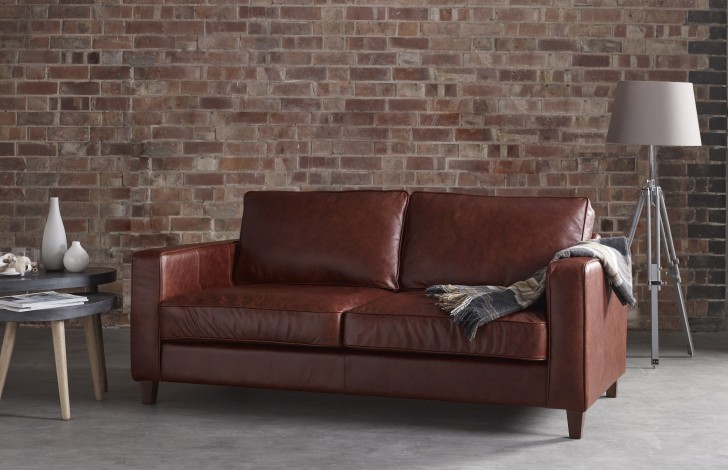
The Art Deco club sofaLow and horizontal, the back curving into a rounded arm over a plinth: the gentleman’s club shape brought into the house, in leather where money allowed and leathercloth where it did not.

Now · The English Sofa Company
Art Deco tan leather sofaThe same rounded club profile in real hide, with grades from corrected full grain to aniline.
See the Art Deco in tan leather →Then · 1930s
The bed-setteeThe settee that opened into a bed answered the small flat and the spare room the semi did not have — a mechanism folded inside a sprung frame.

Now · The English Sofa Company
Art Deco large sofa bedThe Deco club profile with a metal action and slatted base inside, and a sprung mattress as standard.
See the Art Deco sofa bed →Then · 1925–39
Buttoning, thinned outDeep Victorian buttoning survived on the interwar club back as a shallower, wider pattern — texture rather than depth.
Now · The Chesterfield Company
Melrose buttoned-back sofaA buttoned back on a low modern frame, with foam or fibre cushions on a serpentine-sprung seat.
See the Melrose →Modern pieces are shown for comparison only. Their frames are solid beech, their seats are sprung with serpentine springs and filled with foam, fibre or feather-wrapped cushions — the foam being the direct descendant of the latex block developed between the wars, and the serpentine spring the successor of the tension and unit springs that let the interwar seat sit low.
Common misconceptions
“Art Deco was a Modernist style.” They overlapped in date and sometimes in a room, but the V&A separates them: Art Deco drew on tradition and luxury while celebrating the machine; Modernism, from the Bauhaus outward, sought the minimum of material for the maximum strength. A chrome PEL settee and a Betty Joel suite are different arguments.
“Tubular steel furniture was mass-produced from the start.” The V&A notes that most examples of Breuer’s B3 were hand-made in small quantities. Real volume came with PEL’s contract chairs, not the domestic sofa.
“Utility furniture was designed by Gordon Russell.” Russell chaired the design panel, and his working drawings survive; but the pieces themselves were drawn by others — the Chiltern range by Edwin Clinch and Herbert Cutler — and made by licensed firms all over the country, from Enfield to High Wycombe.
“Foam cushions are a post-war invention.” Latex foam cushioning was developed by Dunlop between the wars and sold as Dunlopillo; what came after 1945 was its general adoption, and later the petrochemical foams that replaced it.
Questions people ask
When did Art Deco furniture come to Britain?
From the mid-1920s. The style takes its name from the Paris exhibition of 1925, and the V&A dates it from the boom of the 1920s to the bust of the 1930s. In Britain it reached the drawing room through decorators and makers such as Syrie Maugham, whose shop opened in 1922, and Betty Joel, whose Portsmouth factory dates from 1929, and reached the high street through the Odeon cinemas of 1935 onward.
What is the difference between an Art Deco sofa and a Modernist sofa?
An Art Deco sofa is an upholstered wooden-framed piece with a low horizontal line, curved or stepped silhouette and rich or pale covers, descended from French luxury furniture. A Modernist sofa strips the frame to a chrome steel or bent plywood outline with sprung pads or cushions, following Breuer’s B3 chair of 1925–26. They overlapped in date but argued opposite things: ornament and material against minimum means.
What is a club sofa?
A low, deep sofa with rounded or squared arms and a back that curves into them, usually with loose seat cushions on a sprung platform. The name comes from the leather armchairs of the gentleman’s club; the domestic version, in hide, leathercloth or moquette, became the standard shape of the interwar three-piece suite and was made by firms such as the Buoyant Patent Upholstery Company of Nottingham.
How were 1930s sofas made?
On a beech frame with a coil-sprung or tension-sprung seat, hessian and hair or fibre stitched over, and a top cover nailed or tacked to the rails, with loose spring-interior cushions on top. Better suites used walnut veneers on the show wood; cheaper ones used leathercloth or uncut moquette for the cover. From the late 1920s rubberised hair and latex foam began to replace stitched stuffing in cushions.
When were latex foam cushions invented?
Between the wars. The Science Museum Group records that Dunlop developed latex foam cushioning in the interwar period and sold it through its subsidiary Dunlopillo; the launch date usually given for the trade name is 1929, though that date is not confirmed in the museum record. Foam moulded in one piece replaced the stuffed and stitched cushion and made the post-war foam sofa possible.
What was Rexine, and is it the same as leather?
No. Rexine was a trade name for leathercloth: a cotton fabric coated with nitrocellulose, embossed and coloured to look like hide, made by ICI’s Leathercloth Division at Hyde in Cheshire. It was cheap, durable and easy to clean, and it gave the suite trade a leather look at a fabric price. It was still being used on Utility dining chairs in the 1940s.
What is moquette?
A woven wool pile fabric on a cotton ground, named from the French word for carpet, made on a Jacquard loom. Cut moquette has a velvet-like nap; uncut moquette leaves the loops standing, which is harder-wearing and hides dirt. The London Transport Museum records the first London bus and train pattern, Lozenge, in 1923; the same cloth covered the interwar three-piece suite.
Was Utility furniture well made?
Yes, by specification. The Board of Trade scheme of 1941–52 fixed the dimensions, materials and construction of every approved piece, and the V&A’s Utility drawings run to moisture content and veneer grain. The results were plain and straight-edged, with spring units and Rexine or plain fabric covers, and they fell from favour once restrictions ended in 1953 — but they were sound, and many survive.
Is an interwar three-piece suite comfortable?
Usually more so than its Victorian predecessors, because the seat is lower and deeper and the cushions are loose. Original coil or tension springs may have sagged and horsehair may have compacted after ninety years, and leathercloth covers crack, so a surviving suite often needs re-springing and new cushions. Frames, generally beech, are sound if dry.
What modern sofa is closest to a 1930s Art Deco sofa?
A low club-shaped sofa with rounded or squared arms, a plinth or short turned feet, plain fabric or tan leather and loose cushions. Several English makers produce sofas named for the style; the closest match keeps the horizontal line and the curved arm-to-back junction, and uses foam or fibre cushions on a serpentine-sprung seat in place of the latex and tension springs of the period.
Sources
- Museum of the Home, armchair from a three-piece suite, Buoyant Patent Upholstery Co., Nottingham, 1930–40, 267/1998-1 — collections.museumofthehome.org.uk/object28617
- Museum of the Home, RP6 stacking chair, Bruno Pollak for Pel, 1932, F 15-1 — collections.museumofthehome.org.uk/object23703
- Museum of the Home, Utility dining chairs, Chiltern range model 3A, Clinch and Cutler, 1943–48, F 56-1 and 6/1994 (CC41 460) — collections.museumofthehome.org.uk/object23380
- Museum of the Home, Utility open-arm easy chair Model 2, Clinch and Cutler, 1943–53, 12/1979 — collections.museumofthehome.org.uk/object4502
- V&A, club chair model B3, Marcel Breuer, 1925–28, W.2-2005 — collections.vam.ac.uk/item/O114197
- V&A, model RP6 chair, Pel Limited after Bruno Pollak, 1934–39, W.84:1-1978 — collections.vam.ac.uk/item/O372425
- V&A, Long Chair, Marcel Breuer for Isokon, 1936, CIRC.83:1 to 3-1975; armchair, Gerald Summers, 1934, W.26-1978 — collections.vam.ac.uk/item/O22774
- V&A, desk chair, Betty Joel Ltd, 1929, W.23-1984; screen, Syrie Maugham, 1935, W.146-1978 — collections.vam.ac.uk/item/O144122
- V&A, armchair, Ambrose Heal for Heal & Son, 1928–29, CIRC.610:1, 2-1966; Lloyd Loom armchair model 464, W. Lusty & Sons, 1930, W.6-1992 — collections.vam.ac.uk/item/O132994
- V&A, Art Deco collection introduction; “Art Deco in the home”; “The sophisticated Modern home” — vam.ac.uk/collections/art-deco
- V&A, Utility child’s chair with CC41 mark, 1942–48, MISC.549-1985; Board of Trade Utility design prints, 1947, E.633-1999 and E.636-1999 — collections.vam.ac.uk/item/O184522
- V&A, Gordon Russell, working drawings for the Advisory Committee on Utility Furniture, 1943–52, E.45-1964 and E.54-1964 — collections.vam.ac.uk/item/O1042111
- Science Museum Group, Dunlop Rubber Company Limited (latex foam cushioning, Dunlopillo) — collection.sciencemuseumgroup.org.uk
- Science Museum Group, PEL Ltd (founded 1931, Accles & Pollock, Oldbury) — collection.sciencemuseumgroup.org.uk
- Science Museum Group, Rexine leathercloth sample, ICI Hyde Ltd, 1951, 1976-644/45 — collection.sciencemuseumgroup.org.uk
- London Transport Museum, “A history of moquette” — ltmuseum.co.uk
- Historic England, Odeon Cinema, Sutton Coldfield, list entry 1271848; Domestic 3: Suburban and Country Houses, listing selection guide — historicengland.org.uk
- National Trust, Coleton Fishacre, Devon; “20th century interior design” — nationaltrust.org.uk
- Furniture History Society, BIFMO: Waring & Gillow (1850–1953) — bifmo.furniturehistorysociety.org
- UK Parliament, Hansard, Hire-Purchase Bill, House of Lords, 2 June 1938 — parliament.uk